
Reviewed · JEREZ DE LA FRONTERA TOURS
Jerez: Royal Andalusian School of Equestrian Art Admission
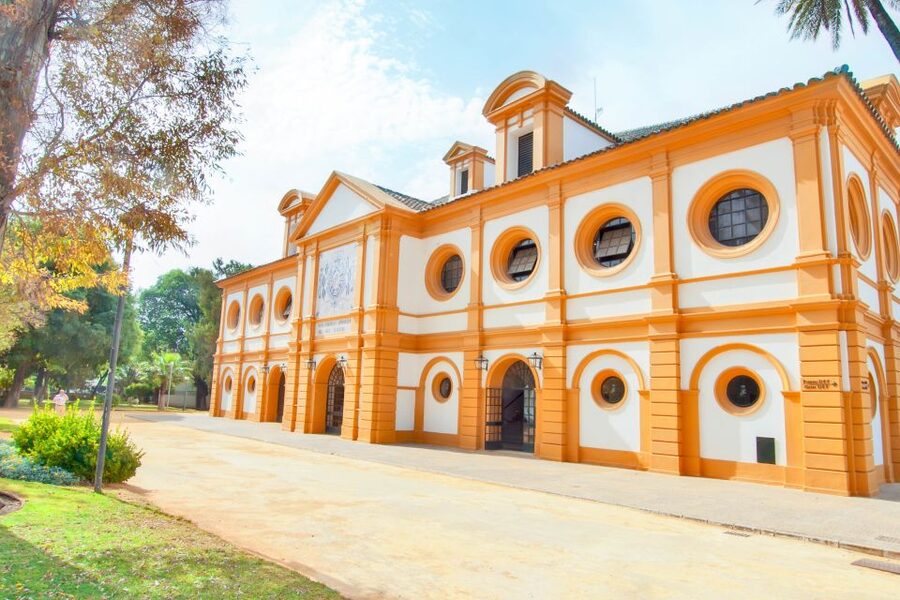
Jerez’s Royal Andalusian School of Equestrian Art gives you a rare look behind the polished show: horses training in the arena, harnesses being maintained, and prized Andalusian horses resting in their stables. This is not just a museum visit. It is a working school.
I like the way the visit combines real horse training with an excellent museum, and I like the chance to see the tack room, saddlery, palace, and carriage collection in one place. The main catch is timing: training and saddlery demonstrations do not take place on Saturdays, and the English tour may not begin until after 11:00.
Key points
- Watch daily training: See horses and riders work in the outdoor rings and indoor arena, except Saturdays.
- Go behind the scenes: A guided visit takes you into the stables, tack room, and saddlery.
- Explore 11 museum rooms: Displays explain Andalusian horses, equestrian traditions, and the school’s work.
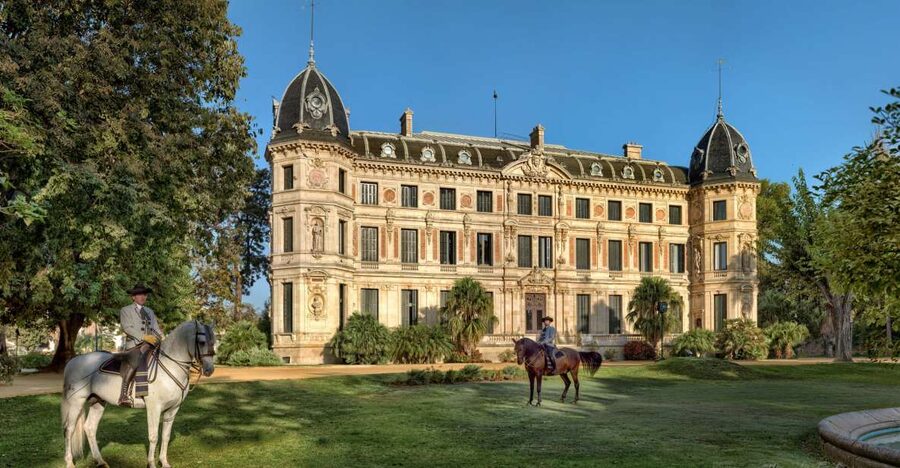
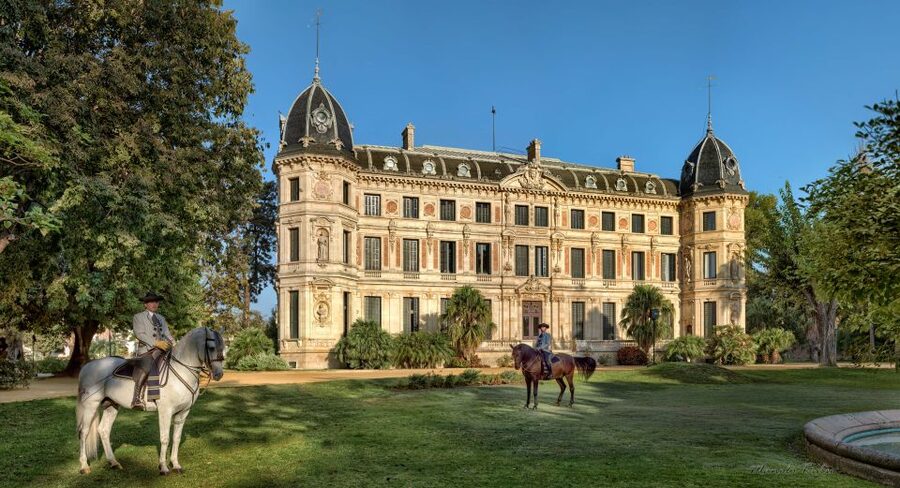
- Tour a Garnier-designed palace: The 19th-century building opens onto formal gardens and a large central fountain.
- Allow extra time: The advertised visit lasts two hours, but the grounds and museums can keep you busy for much longer.
- Know what your ticket covers: This admission is for the school facilities and training visit, not automatically the full horse show.
Why the school visit is more than a horse museum
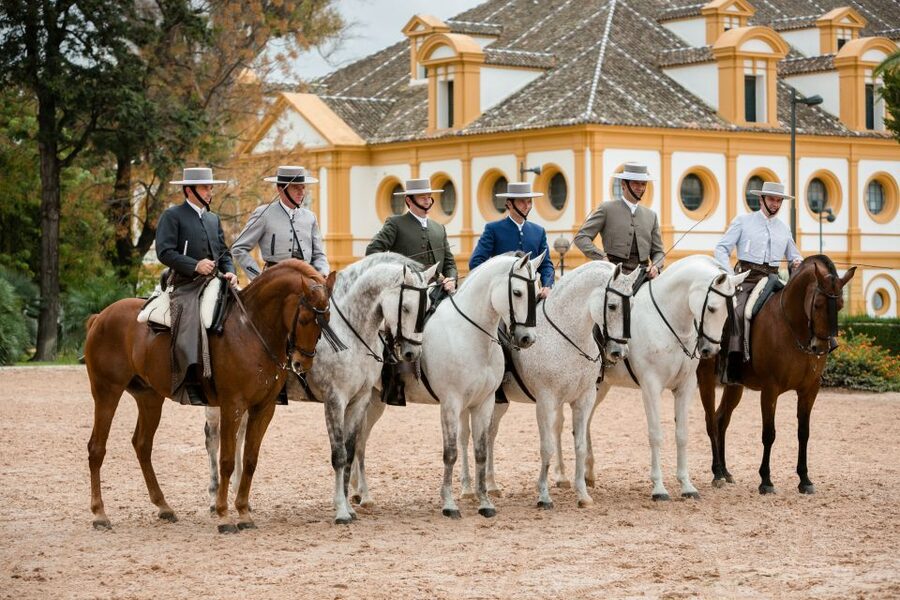
The Royal Andalusian School of Equestrian Art is one of Jerez’s most distinctive sights because you see the institution at work. The horses are not simply posed for display. They are trained, groomed, housed, and prepared for performances on the same grounds you visit.
That difference matters. You get a better sense of the daily discipline behind Andalusian equestrian shows. In the indoor arena, you can watch horses and riders rehearse movements that later appear in public performances. The horses are the clear stars, but the visit also shows the staff, buildings, equipment, and routines that support them.
The experience is priced at about $18 per person, which is good value if you have an interest in horses, riding, craftsmanship, or Jerez’s cultural traditions. The ticket gives access to the school facilities, including the museum and carriage collection. It is also a practical alternative when you cannot fit a performance into your schedule.
Do not confuse this admission with a ticket to the famous horse show. The training visit lets you watch work in the rings, while a staged performance is a separate experience. Check exactly which option you are booking before you pay.
A few other Spain outings to compare
- Jerez de la Frontera: Andalusian Horse Dance and Museums
★ 4.7 · 1,289 reviews - Jerez: Yeguada de la Cartuja Carthusian Horses Tour
★ 4.8 · 970 reviews - Jerez: Bodegas Fundador Guided Tour with Tasting Session
★ 4.8 · 714 reviews
Start in the gardens and visitor center
Your visit begins at the reception center, where you present your printed receipt or mobile ticket at the ticket office. Discounted tickets require proof of eligibility. If you cannot show the required document, you may have to pay the difference to the full price, assuming standard tickets are still available.
At the visitor center, an audio-visual presentation explains the development of equestrian art in Andalusia. It is available until 11:00 in the morning, so an early arrival gives you the best chance of seeing it. Some past visits have had delays or canceled video presentations, and a few museum video displays have not worked, so treat this as a useful introduction rather than the main reason to come.
From the reception area, you enter the gardens. The setting is calm and formal, with exotic plants arranged around a large fountain. Water jets rise at the center and draw your eye toward the palace beyond. This opening gives you time to get your bearings before the more practical parts of the school tour.
The gardens are also a welcome pause if you visit during Jerez’s hot months. Keep in mind that some parts of the grounds and the carriage museum may feel exposed in strong heat. Comfortable shoes, water before entering, and a sensible pace will make the visit easier.
Tour the 19th-century palace
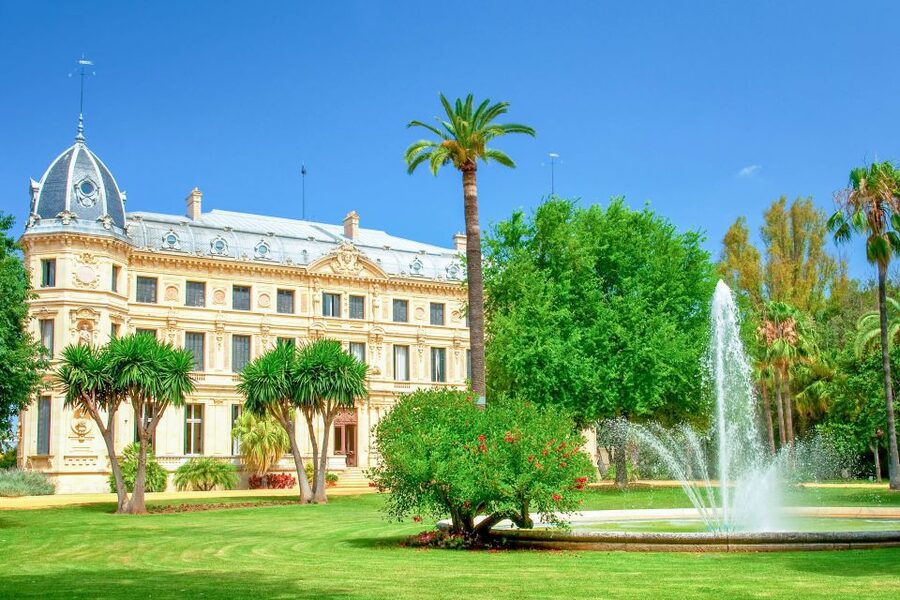
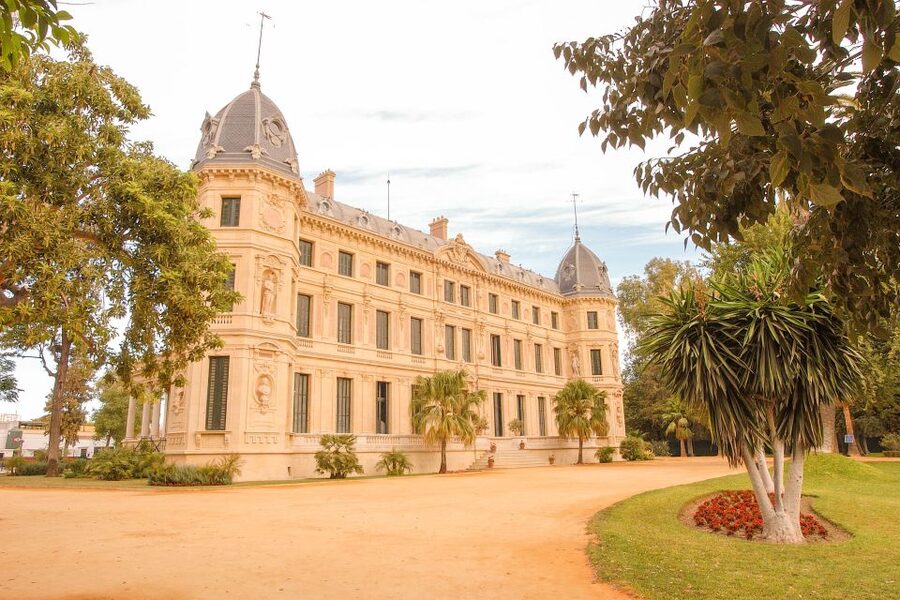
Across the fountain, the palace rises above the gardens in a grand 19th-century design by Charles Garnier. The name may be familiar because Garnier also designed Paris’s famous opera house, but here the setting is more restrained and distinctly Andalusian in feel.
The palace rooms on the ground floor are decorated in their original style. You are not simply passing through an empty historic shell. The rooms help explain the formal side of the school and provide a contrast to the practical work taking place in the stables and arena.
Access to the palace can vary. One past visit found part of the house closed for filming, and the management can alter the program. If the palace is especially important to you, keep your expectations flexible.
The building is worth seeing even if your main interest is horses. It helps connect the school’s public image, its formal ceremonies, and its training work. The visit feels less like a single attraction and more like a small working estate with several distinct parts.
The 11-room Museum of Equestrian Art
In the basement, the Museum of Equestrian Art covers the origins and development of the horse in Andalusia. Its 11 rooms explain the relationship between horses, riding, training, and regional culture.
The displays include interactive exhibits and video material, though not every screen is guaranteed to be working. The museum is still useful because it gives context before or after you watch the horses. Without that background, the training can look like a series of beautiful movements. With it, you have a clearer idea of why particular skills matter.
I would not rush this section. Look for the links between the horse, the rider, the equipment, and the traditions of Andalusian horsemanship. The museum also explains the school’s role and the demanding movements performed by its horses.
If you are mainly visiting for live action, you may be tempted to hurry through. Resist that urge if you have time. The museum is one of the best places to understand what you are seeing in the arena.
Same city, a completely different evening:
- Barcelona: Sagrada Familia Entry Ticket with Audio Guide
★ 4.6 · 105,312 reviews - Barcelona: Park Güell Admission Ticket
★ 4.4 · 76,534 reviews - Seville: Royal Alcázar Entry Ticket
★ 4.6 · 28,378 reviews - Barcelona: Casa Batlló Entry with Self-Audioguide Tour
★ 4.7 · 25,359 reviews
See the saddlery and working equipment
One of the most interesting stops is the saddlery, where harnesses are made and repaired. This is a working craft area, not a decorative display. A master harness maker and apprentices handle the careful work needed for daily training and public shows.
You can see how much labor sits behind a polished performance. Harnesses must fit correctly, remain in good condition, and be ready for repeated use. The visit puts the equipment on the same level as the horse and rider, showing that equestrian art depends on precise preparation.
The saddlery visit is not available on Saturdays. That restriction is important if you are planning around a weekend in Jerez. The wider school may still offer plenty to see, but you should not expect the full behind-the-scenes program that day.
Watch training in the outdoor rings
The outdoor exercise rings are where the school’s daily routine becomes visible. Horses and riders work through their training, giving you a chance to see the precision behind dressage and the school’s public performances.
The exact program can change, but past visits have included stallions being lunged, carriage driving, and riders working horses in the arena. You may also be able to watch training after the guided portion of the visit, so do not leave immediately when the tour ends.
The indoor arena is built in an authentic Andalusian style and holds up to 1,600 people. During a regular training visit, it gives you a proper view of the riders and horses at work without the full staging of a show.
Photography rules can be strict. One past visit did not allow photographs inside the arena, so follow staff instructions rather than assuming you can use your camera everywhere. The most useful part of the arena visit is watching the riders’ control and the horses’ response, not collecting a large number of pictures.
Training does not take place on Saturdays according to the published schedule. If seeing horses in motion is your priority, choose another day and check the available start time carefully.
Meet the horses in the octagonal stables
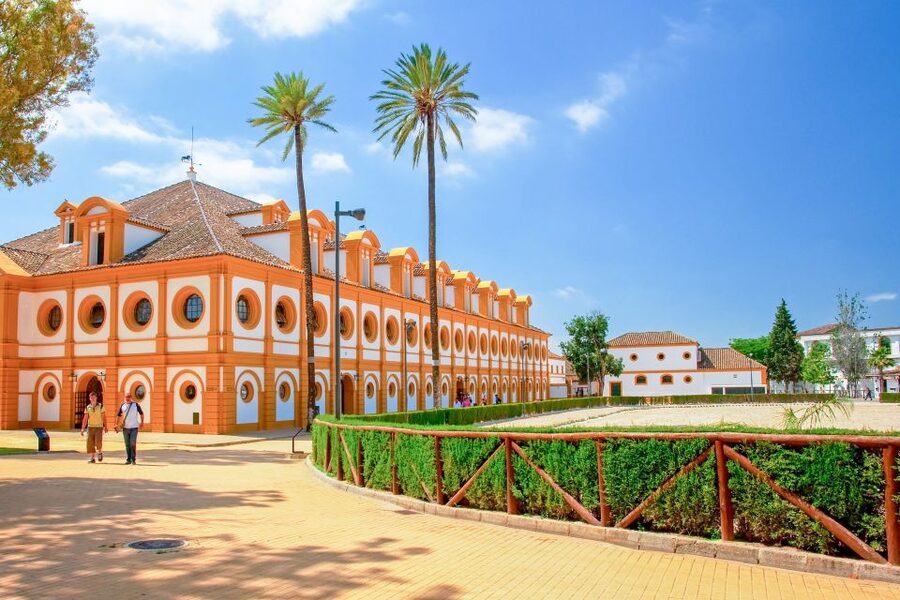
The stables are arranged in an octagonal complex, with the tack room at the center. This layout lets you see the school’s most emblematic horses and the equipment used for both daily work and shows.
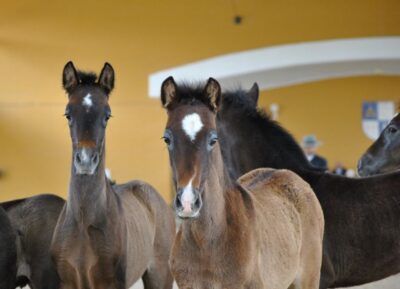
The horses are kept behind the stable areas, so you should not expect a petting zoo. Some visitors have been allowed close enough to touch a horse, but another visit found it disappointing that no horse was brought out for visitors to pat. The safe assumption is that you will observe the horses at close range, not handle them.
That is still a valuable part of the visit. You see the horses where they live, rather than only in a performance setting. You can also ask questions about their care and training during the guided portion.
The tack room is especially memorable. Harnesses used every day are stored there, and the space is humidity controlled. That detail shows how seriously the school treats its equipment. Fine leather and other materials need careful care, just as the horses do.
Several guides have received strong praise for their clear explanations. Javi, Elena, and Harry are among the guides specifically singled out for making the stable visit interesting and for answering questions. Your guide may be someone else, but the tour can be led in Spanish, English, French, or German. One useful detail is that the guide may be a school employee, giving you direct insight into the institution rather than a general city tour.
Finish with the carriage museum
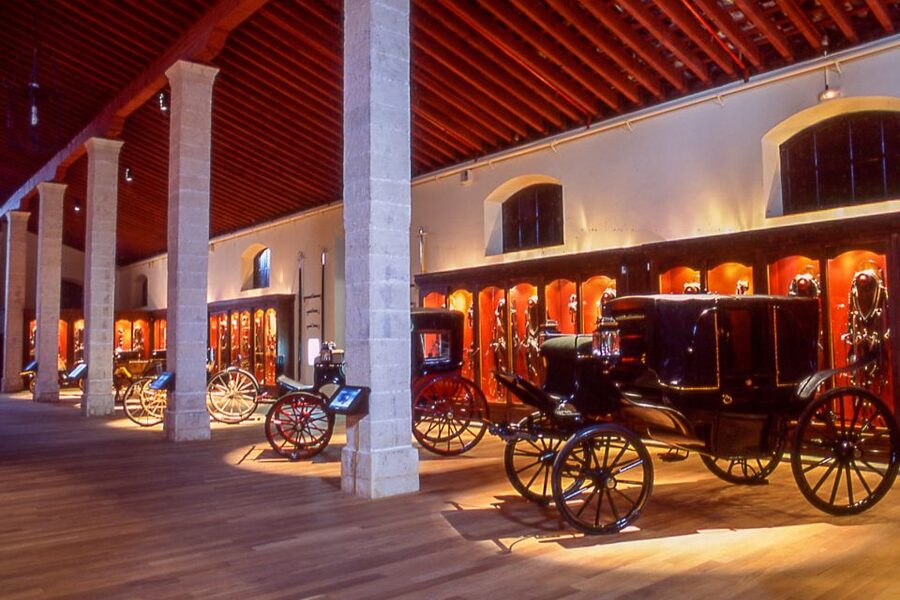
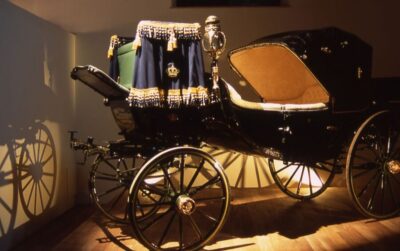
The carriage museum completes the circuit. Its collection includes carriages, horses, harnesses, and equestrian costumes. This final stop broadens the focus beyond dressage and shows how horses were used in transport, ceremony, and formal display.
You may find the carriage museum less exciting than the live training, especially if the weather is hot or your energy is fading. Still, it is included in the admission and adds useful context. The vehicles show how much style and practical engineering went into horse-drawn travel.
Plan your route so you do not skip it by accident. The carriage museum is farther from the main stable areas, and one past visit ended without seeing it because of the heat. If you have paid for the full school admission, it is worth making the extra walk when conditions are comfortable.
How long should you allow?
The stated duration is two hours, which is a fair estimate for a guided visit that includes the key facilities. In practice, you may want three or four hours if you plan to watch training, study the museum, walk through the gardens, and see the carriage collection at an easy pace.
The order can vary. You might begin with the audio-visual presentation, join a guided tour of the stables, watch training, and then visit the palace and museums. Or you may find that the timing of the day’s training shapes your route.
The school has a lot to see for the admission price, but opening hours and program times matter. Older information notes that some areas shut by 2:00 in the afternoon, so do not assume you can arrive late and still see every part. Check the current availability and start times when booking.
An early start is especially useful if you want the introductory presentation. It can also help you avoid arriving when several groups are being processed at the ticket office. Even with an online ticket, you may need to queue at the ticket counter to collect or validate entry materials.
What the $18 ticket is really worth
At $18, this is one of Jerez’s better-value cultural visits if you care about horses or want something beyond the city’s bodegas and churches. You receive access to the palace areas, gardens, equestrian museum, stables, tack room, saddlery viewing, training facilities, and carriage museum, subject to the day’s schedule.
The value comes from the variety. A museum alone might take less time. A stable visit alone might feel brief. Here, each part fills in a different piece of the picture.
The ticket is less satisfying if you expect a full performance or a guaranteed chance to touch a horse. It is also less ideal on a Saturday, when training and saddlery work are not part of the normal program. For the best return, visit on a weekday when training is scheduled and allow enough time to see the museums.
Free cancellation up to 24 hours before the visit and a reserve-now, pay-later option make the booking fairly flexible. Those terms are useful if your Jerez plans may change, but you still need to arrive with the correct ticket and any required discount proof.
Who should book this experience?
I would recommend it first to horse lovers, riders, and anyone curious about Spanish dressage. The Andalusian horses are beautiful, but the real appeal is seeing their training and care up close.
It also suits visitors who want a quieter, more unusual Jerez experience. You get gardens, architecture, museum displays, traditional craft, and live practice in one stop. You do not need to be an expert rider to enjoy it, since the guide explains the equipment, the horses, and the school’s work.
Families can find plenty to look at, though the visit includes museum reading and guided explanations rather than constant action. Anyone with limited mobility should note that the experience is wheelchair accessible.
The main group who should think twice is anyone looking specifically for the staged show. Book the performance separately, or choose a ticket that clearly includes it. This admission is best understood as a working-school visit, with training rather than theatrical presentation at its center.
Should you book the Royal Andalusian School?
Yes, if you can visit on a day when training is scheduled and you want to see the working side of Andalusian horsemanship. The combination of stables, tack room, arena, saddlery, museum, palace, and carriage collection gives you plenty for the price.
Book with realistic expectations. You may not touch a horse, the introductory video may not be running, some exhibits may be unavailable, and the palace program can change. But the horses, the clean facilities, the skilled riders, and the chance to see daily preparation make this a strong choice in Jerez.
For the best visit, choose a weekday morning, confirm the language and start time, arrive with your ticket ready, and allow more than two hours if possible.
FAQ
How much does admission to the Royal Andalusian School cost?
The listed price is $18 per person.
How long does the visit last?
The stated duration is two hours. You may spend closer to three or four hours if you watch training and take your time in the museums, gardens, and carriage collection.
Is horse training included?
Yes, daily horse and rider training is included when scheduled. Training is not available on Saturdays.
Can I see the saddlery?
Yes, the visit includes the saddlery, where harnesses are made and repaired. Saddlery work is not available on Saturdays.
Is the horse show included?
The standard admission described here covers the school facilities and training visit. It does not automatically include the staged horse show.
What languages are available for the guided tour?
Guided tours are available in Spanish, English, French, and German.
Is the attraction wheelchair accessible?
Yes, the activity is listed as wheelchair accessible.
Do I need to bring my ticket?
Yes. You must show your printed receipt or mobile ticket at the ticket office.
What is required for a discounted ticket?
You must show proof that you qualify for the discount. Without documentary proof, you may need to pay the difference to the full standard price if tickets remain available.
Can I bring bottles, cans, or animals?
No. Bottles, cans, animals, and objects that management considers unsuitable are not allowed inside the grounds.
Recently added in Spain
- From Andratx: Formula Sunset Driving Tour★ 4.8 · 176 reviews
- Barcelona: Catamaran Cruise w/ Sailing, Wine, & Tapa★ 4.7 · 176 reviews
- Entrance to the Flamenco Temple Room in Madrid with Tapas Option★ 5.0 · 176 reviews
- Fuerteventura: Round-Trip or 1-Way Ferry Ticket to Lanzarote★ 4.7 · 176 reviews
- Mallorca Sailing Adventure with Snorkeling, Snacks & Drinks★ 5.0 · 176 reviews
- Valencia Private Walking Tour with Official Valencian Guide★ 5.0 · 176 reviews
- Benahavís: Canyoning Guided Tour at Guadalmina River★ 5.0 · 177 reviews
- Guided Gaudí Trencadís Mosaic Workshop in Barcelona 2 Hours★ 5.0 · 176 reviews
Jerez De La Frontera Tours, compared.
Bodegas Fundador Guided Tour with Tasting Session
Read the review →
Bodegas Álvaro Domecq Guided Tour with Wine Tasting
Read the review →
Flamenco Show and Menú at Tablao Puro Arte 2025
Read the review →Browse the lists this tour appears in