
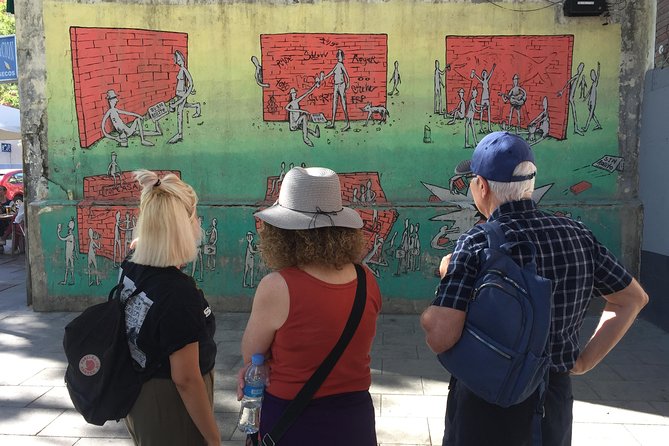
Reviewed · MADRID TOURS
Street Art Guided Tour in Madrid
Madrid’s street art is not confined to a gallery. It spills across old industrial walls, basement corridors, community gardens, and the multicultural streets of Lavapiés. This two-hour walking tour gives you a useful way into that world, with stops connected to protest, public space, and local creative life.
I like two things right away: the route brings you to places you might skip on a standard Madrid visit, and guides such as Santi and Julia have been praised for making the art easy to understand without draining away its edge. The small maximum of 13 people also helps keep the walk personal.
The main consideration is that street art changes fast. A mural may be newly painted, covered, or inaccessible, and La Tabacalera has restricted weekday hours. This is a good tour for curiosity and context, not a guaranteed checklist of famous walls.
Key details of Madrid’s street art walk

- Lavapiés is the main setting: Explore one of Madrid’s most multicultural districts while learning how its streets became a canvas for local artists.
- La Tabacalera anchors the route: See the exterior graffiti walls of a former tobacco warehouse and, when open, its basement stencils and art projects.
- Esta es Una Plaza adds a community angle: Visit the walls of a reclaimed urban garden when the space is open.
- Local guides shape the experience: Santi, Julia, and other guides have led walks that connect individual works with neighborhood life, festivals, and Spanish graffiti law.
- The route ends at Plaza de Cascorro: You finish near La Latina and Tirso de Molina metro stations, a handy spot for continuing your Madrid day.
Why Lavapiés is the right neighborhood for street art
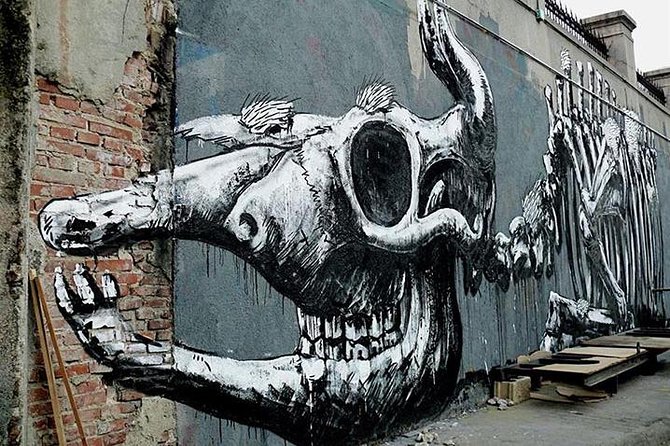
Lavapiés gives this tour more substance than a simple mural hunt. The district is multicultural, crowded with independent activity, and full of changing walls. As you walk, the guide explains how art fits into the neighborhood rather than treating each painted surface as an isolated decoration.
That context matters. Some works are sanctioned murals created for festivals. Others are unofficial pieces, quick tags, stencils, or political statements. You will hear about the artists, the methods they use, and the messages behind the work.
The route also shows how street art can connect with public life. A painted wall may sit beside a community garden, a performance venue, or a former factory. You are not just looking at color. You are seeing how local groups and artists use neglected or reclaimed spaces.
The tour begins at Teatro Valle-Inclán in central Madrid at 11:15 a.m. From there, the walk heads toward the first art stop. Wear comfortable shoes. The tour operates in all weather, so bring protection from rain or sun as needed.
A few other Madrid outings to compare
- Madrid: Street Art Tour with Local Graffiti Hunter
★ 4.8 · 270 reviews - Barcelona Street Art and Graffitti Bicycle Tour
★ 5.0 · 361 reviews
The walk toward La Neomudéjar and Atocha
The tour information describes La Neomudéjar as an early stop, about a five-minute walk from the meeting point. On the way, you pass the big-headed babies monument near Atocha train station and the avant-garde art center located at the station’s Mediodía metro area.
This opening section is useful because it eases you into Madrid’s less conventional art scene. You begin with a public monument and a transport hub that has made room for photography and gallery exhibitions, then move toward a former industrial building now used by artists.
La Neomudéjar once served as a power plant connected to the train station in the 19th century. Today, its industrial setting provides room for national and international street artists, including Himen, Ze Carrión, and Laguna626.
The art here also has a political side. Some artists use their work to protest Article 626, a Spanish law associated with penalties for graffiti creators. Your guide can help explain why a painted wall may represent more than a visual flourish. It can also reflect a dispute over who controls public space.
Access and exact stops can vary. The detailed route places particular focus on La Tabacalera, Esta es Una Plaza, and Lavapiés, while the broader tour description includes La Neomudéjar and Campo de Cebada. If one site matters most to you, confirm the day’s route when booking.
La Tabacalera’s walls, basement, and changing schedule
La Tabacalera de Lavapiés is the clearest fixed point on the detailed route. This former 19th-century tobacco warehouse once employed more than 1,000 people cutting, shredding, and rolling tobacco.
Today, the building is linked with exhibitions, dance, music, painting, and other creative work. The exterior walls are especially important for street-art fans. The guide points out the artists, the messages, and the techniques used in the murals and graffiti.
The site is also connected with one of Madrid’s major urban-art festivals. If your visit happens around a festival period, you might see recent murals or artists working on new pieces. That timing can make the walk feel unusually current, though it is not something you can count on.
When the building is open, the tour can include the basement, where stencils and street-art projects cover the walls. This is a different experience from viewing a large exterior mural. The basement gives you a closer look at layers of work, repeated motifs, and smaller-scale techniques.
There is an important catch: La Tabacalera has restrictive weekday timing. The exterior walls may still be part of the walk, but interior access is not always assured. If you are booking mainly for the basement, ask about opening hours rather than assuming it will be available.
Esta es Una Plaza and the value of reclaimed space
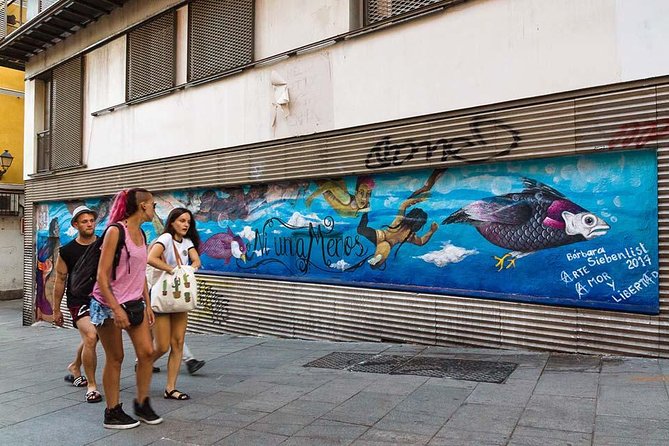
Esta es Una Plaza is an urban garden and community project in Lavapiés. The tour includes the garden’s walls when the location is open. That condition is worth taking seriously, since you may see the exterior area without entering the garden itself.
This stop helps explain a broader theme of the walk: street art often shares space with local projects. A community garden is not a traditional gallery, yet its walls can carry artistic and social meaning.
You might find that this stop feels less polished than a formal exhibition. That is part of its appeal. The setting shows how residents can reshape unused space for gardening, gatherings, and neighborhood use.
The stop is listed at about 30 minutes. That gives the guide time to discuss the wall art rather than rushing past it for a quick photograph. Still, the exact amount of time may depend on access and the pace of the group.
Same city, a completely different evening:
- Madrid: Tour Bernabéu Entry Ticket
★ 4.5 · 21,573 reviews - Madrid: Prado Museum Entry Ticket
★ 4.6 · 17,509 reviews - Madrid: Royal Palace Fast-Access Admission Ticket
★ 4.6 · 13,856 reviews - Madrid: “Emociones” Live Flamenco Performance
★ 4.8 · 12,866 reviews
Campo de Cebada and Madrid’s public square movement
The wider route description also includes Campo de Cebada, known in English as The Barley Field. It began through the 15-M Movement, when citizens reclaimed streets and squares for communal use.
The site once held a swimming pool. Local associations later turned it into a public gathering place where residents could watch summer films, hear music, and grow vegetables in a shared garden.
Campo de Cebada shows how art and civic action overlap in Madrid. The point is not simply to find another painted wall. It is to see how an unused or altered public site can become useful again.
As with La Neomudéjar, this stop should be confirmed if it is central to your decision. The more detailed stop information lists La Tabacalera, Esta es Una Plaza, and Lavapiés, while Campo de Cebada appears as the finishing point in the broader route description. Tour paths can shift with access, events, and changing street art.
What the guides add to the walk
A strong guide matters more here than on a standard sightseeing route. Street art does not come with labels, dates, or a simple official story. You need someone who can explain who made the work, what techniques are visible, and how the piece fits the local area.
The most highly praised guides have been Santi and Julia. Santi is an active street artist, and his connection with the neighborhood adds a useful personal angle. Julia has been described as informative, friendly, and especially good with families.
Other guides may lead the walk, so you should not book on the assumption that one specific person will be present. Still, the experience is designed around a local guide rather than an audio recording or a self-guided map.
You can ask questions and follow your own interests. If you care about political art, festival murals, spray-paint technique, or the history of Lavapiés, say so early. One especially hands-on version of the tour has included a chance to try spray painting, but treat that as a possible feature rather than a guaranteed part of every departure.
A small group helps. With a maximum of 13 people, you have a better chance of hearing the explanation and getting close to a wall without blocking the pavement. One practical issue is that the guide may need to stop the group at set points rather than talk while walking. Stay near the guide when explanations begin, especially in noisy streets.
What you will and will not see
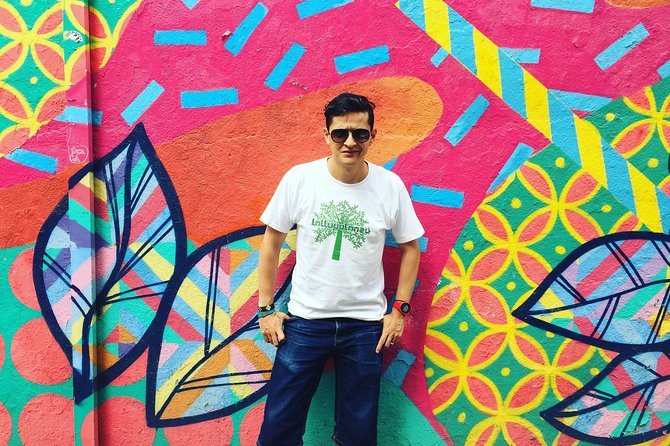
The art is temporary. Madrid’s walls change with festivals, new commissions, weather, building work, and fresh graffiti. A guide may point out a recently completed mural one month and find it altered the next.
This can be exciting, but it also creates uneven days. You might catch artists painting new work for the annual Calle Lavapiés festival. You might instead see older pieces, small stencils, or walls that seem less impressive than photographs used to promote the walk.
The tour is strongest when you want to understand the scene. It is less suitable if you expect a tightly edited procession of only large, polished murals.
You will see both sanctioned and unofficial art. The guide can explain the difference and discuss how Spanish law affects graffiti creators. That distinction gives the route a useful edge, since you are looking at a living debate rather than a finished museum display.
Price, timing, and practical value
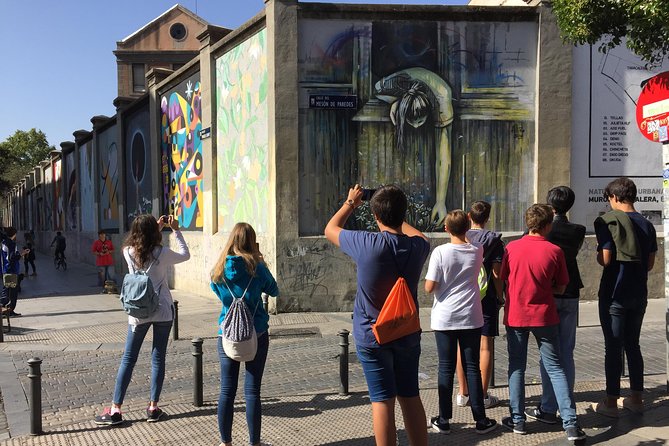
At $30.38 per person, the tour is fairly priced for a two-hour guided walk with a small group and a local guide. Admission to the listed stops is free, so you are paying for interpretation, route planning, and access to places you might not locate on your own.
The value is best if you are new to Madrid or want a break from major monuments. You receive neighborhood context, a walk through Lavapiés, and explanations of works that may otherwise look like random paint.
If you already know Lavapiés well and can comfortably research street art on your own, the price may feel less attractive. The route does not include food, drinks, hotel pickup, or drop-off. You make your own way to Teatro Valle-Inclán and leave the tour at Plaza de Cascorro.
The starting point is close to public transportation. The ending point is near La Latina and Tirso Molina metro stations, so you can continue toward other parts of central Madrid without much trouble.
The tour is available in English, and the included guide service is listed as multilingual in English, French, and Spanish. Confirmation arrives at booking. Service animals are allowed, and most people can take part, though this is a walking tour through city streets.
Free cancellation is available if you cancel at least 24 hours before the local start time. Cancellations or changes made within 24 hours are not refunded.
Who should book this Madrid art walk
I would choose this tour if you want to see a side of Madrid beyond the Prado, Royal Palace, and grand boulevards. It suits first-time visitors who enjoy street photography, public art, social history, or neighborhood walks.
It also works well for families with older children who are interested in making art. The chance to see murals and perhaps try spray painting can hold attention better than a formal gallery visit, though the hands-on activity is not guaranteed.
You should think twice if you need a fixed route with guaranteed interior access. La Tabacalera’s schedule can limit the basement visit, Esta es Una Plaza is open only at certain times, and street art itself can change without notice.
Book it early if your dates are fixed. The tour is booked about 16 days ahead on average, and the maximum group size is 13. You may also want to avoid making the tour your only art plan in Madrid. Treat it as a focused neighborhood walk, not a replacement for the city’s major museums.
Should you book the Street Art Guided Tour in Madrid?
Yes, if you want context as well as photographs. The best parts are the guide’s personal connection with the art, the walk through Lavapiés, La Tabacalera’s changing walls, and the chance to see how Madrid’s artists and community groups use public space.
I would book it for the neighborhood and the explanations, not for a guaranteed list of famous murals. Ask about the day’s route and La Tabacalera’s interior access before paying, especially if La Neomudéjar, Campo de Cebada, or the basement is a priority.
At $30.38, it offers good value for a small-group introduction to a creative part of Madrid. Bring comfortable shoes, stay close enough to hear the guide, and expect the art to be temporary. That uncertainty is part of what makes the walk feel connected to the city rather than sealed off from it.
FAQ
How long does the Street Art Guided Tour in Madrid last?
The tour lasts approximately two hours.
Where does the tour begin?
The meeting point is Teatro Valle-Inclán, Pl. de Ana Diosdado, s/n, Centro, Madrid, 28012, Spain.
What time does the tour start?
The stated start time is 11:15 a.m.
Where does the tour end?
The tour ends at Plaza de Cascorro in central Madrid. The nearest metro stations are La Latina and Tirso Molina.
Is the tour offered in English?
Yes. The experience is offered in English, and the included guide service is listed as multilingual in English, French, and Spanish.
What is included in the price?
The price includes a local guide and a visit to the Muros La Tabacalera area.
Are food and drinks included?
No. Food and drinks are not included.
Is hotel pickup available?
No. Hotel pickup and drop-off are not included.
Can the tour operate in bad weather?
Yes. The tour operates in all weather conditions, so you should dress appropriately.
Can I cancel for a full refund?
Yes, if you cancel at least 24 hours before the experience start time. Cancellations or changes made less than 24 hours in advance are not refunded.
Recently added in Madrid
- Madrid: Top Pub Crawl Madrid & Party★ 5.0 · 173 reviews
- Madrid Gourmet Tapas Small Group Tour★ 5.0 · 175 reviews
- Iberian Ham and Wine Small Group Tour in Madrid★ 5.0 · 176 reviews
- Entrance to the Flamenco Temple Room in Madrid with Tapas Option★ 5.0 · 176 reviews
- Tapas & Paella Cooking Class in Madrid with a Professional Chef★ 5.0 · 177 reviews
- Madrid: Toledo Day Trip with Winery Visit and Wine Tasting★ 4.4 · 177 reviews
- VIP visit to the Las Ventas Bullring in Madrid★ 5.0 · 178 reviews
- VIP Entrance Ticket to Our Secret Alley in Madrid★ 5.0 · 179 reviews
Madrid Tours, compared.




Live Flamenco Show with Food and Drinks Options
Read the review →
Avila & Segovia Tour with Tickets to Monuments from Madrid
Read the review →
Three Cities in One Day: Segovia, Avila and Toledo from Madrid
Read the review →
Segovia and Toledo Tour, Alcazar, and Cathedral
Read the review →
Royal Palace Expert Guided Tour with Skip-the-Line
Read the review →Browse the lists this tour appears in