Reviewed · TICKETS
Barcelona: Cathedral of Barcelona Entry Ticket
Barcelona Cathedral gives you two very different visits in one: a solemn Gothic church below and a breezy rooftop lookout above. The cloister garden is the unexpected star, with orange trees, palms, a fountain, and the cathedral’s famous white geese.
I like the easy entry and the elevator access to the roof, especially if stairs are a concern. I also like having the virtual audioguide in six languages, since there is no live guide included. The main drawback is timing: the small lift can create a 20 to 30 minute wait, and a broken elevator can remove one of the best parts of the visit.
Key points to know before you go
- The rooftop is reached by elevator, making the views accessible without a long climb.
- The cloister holds 13 white geese, a long-running Barcelona Cathedral tradition.
- The Chapter Hall is a small museum, with an 11th-century baptism font and a sculpture of Saint Eulalia.
- The virtual audioguide works in six languages, including English, Spanish, Catalan, German, Italian, and French.
- Plan on one to two hours, with extra time if the rooftop queue is long.
- Cover your shoulders and leave hats at your accommodation, since dress rules are enforced.
Why Barcelona Cathedral is worth your time
Barcelona has no shortage of impressive churches, but the Cathedral of Barcelona offers a pleasant change from the city’s most heavily visited sights. It sits in the Gothic Quarter, where narrow lanes and old stone buildings make the approach part of the experience.
The cathedral grew through centuries of construction, with major Gothic work dating from the 13th and 14th centuries and further work continuing into the 15th century. You are not looking at one perfectly planned building. You are looking at a place shaped, repaired, expanded, and decorated over a long stretch of time.
That slow growth explains the cathedral’s layered feel. The building has a grand interior, carved chapels, a cloister garden, rooftop views, and a museum room. None of these sections takes very long on its own, but together they make a worthwhile stop in the Gothic Quarter.
At $23 per person, the ticket is not the cheapest church admission in Barcelona. The value depends on using the full package. If you only step inside the nave for ten minutes, it may feel expensive. If you explore the cloister, use the audio guide, visit the museum, and wait for the roof, the price is easier to justify.
A few other Barcelona outings to compare
- Barcelona: Sagrada Familia Entry Ticket with Audio Guide
★ 4.6 · 105,312 reviews - Barcelona: Park Güell Admission Ticket
★ 4.4 · 76,534 reviews - Barcelona: La Pedrera-Casa Milà Ticket & Audio Guide Option
★ 4.7 · 15,099 reviews
Entering through the Pieta and Saint Eulalia doors
The visit begins through the external doors of Pieta and Saint Eulalia. From there, you enter the cathedral’s cloister rather than simply walking straight into the main church.
The first interior doorway is Romanesque, made from white marble and framed by archivolts with geometric decoration. Above it is a Gothic pediment. This transition gives you a quick lesson in Barcelona’s architectural timeline before you even reach the main spaces.
Take a moment here instead of rushing toward the rooftop. Details in this doorway are easy to miss when you are focused on the ticket check or looking for the next room. The cathedral rewards slow looking, especially if you enjoy carved stone and old religious art.
The entry process is generally straightforward, and a prebooked ticket helps you avoid the uncertainty of buying admission at the door. It also gives you a selected entry time, though the visit itself is self-guided rather than led by a member of staff.
The cloister garden and its famous geese
The cloister is the most distinctive part of the visit. Four galleries are formed by ogive arches, with pillars dividing each section. Look closely at the reliefs on the pillars, which show scenes from the Old Testament.
The vault keystones add another layer of decoration, with scenes from the New Testament. You can use the virtual audioguide to put these carvings into context, or simply wander and pick out the scenes you recognize.
Small chapels line three of the galleries. Each chapel was originally linked to a patron saint, an institution or guild, and a particular family. That arrangement tells you something practical about medieval religious life: the cathedral was not only a place of worship, but also a social and civic center supported by organized groups.
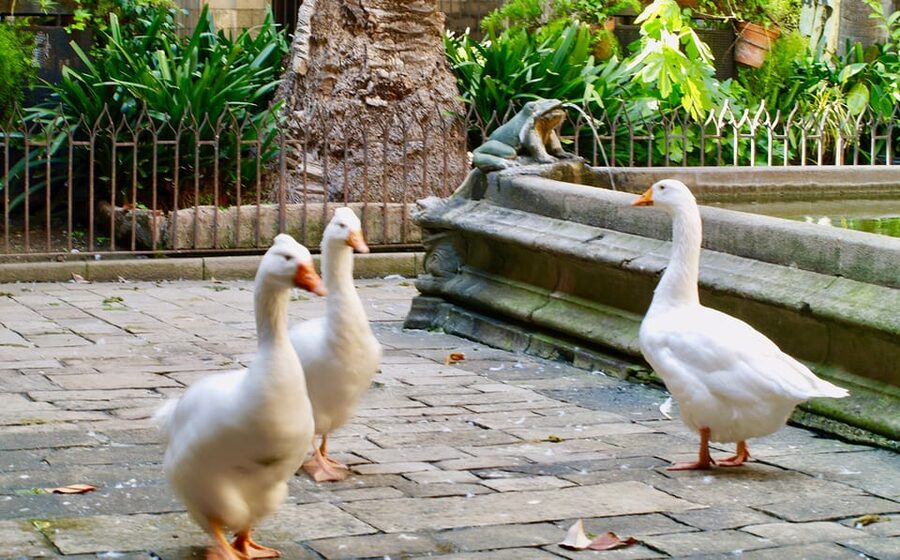
Then comes the garden. Palms, magnolias, and an orange tree soften the hard stone of the cloister. A fountain sits at the center, and the annual ou com balla, or dancing egg, takes place here during Corpus Christi. The tradition involves an egg balanced and made to dance on a jet of water.
The pond is home to the cathedral’s 13 white geese. They are a charming feature, but the enclosure is not especially large, and you should not expect a wildlife park. The geese are part of the cathedral’s identity and a small piece of living tradition, not the main attraction.
This is a good place to pause. The cloister feels quieter than the streets outside, and the garden provides a welcome break from the dark interior. If you have children with you, the geese may be the detail they remember best.
The Gothic interior and side chapels
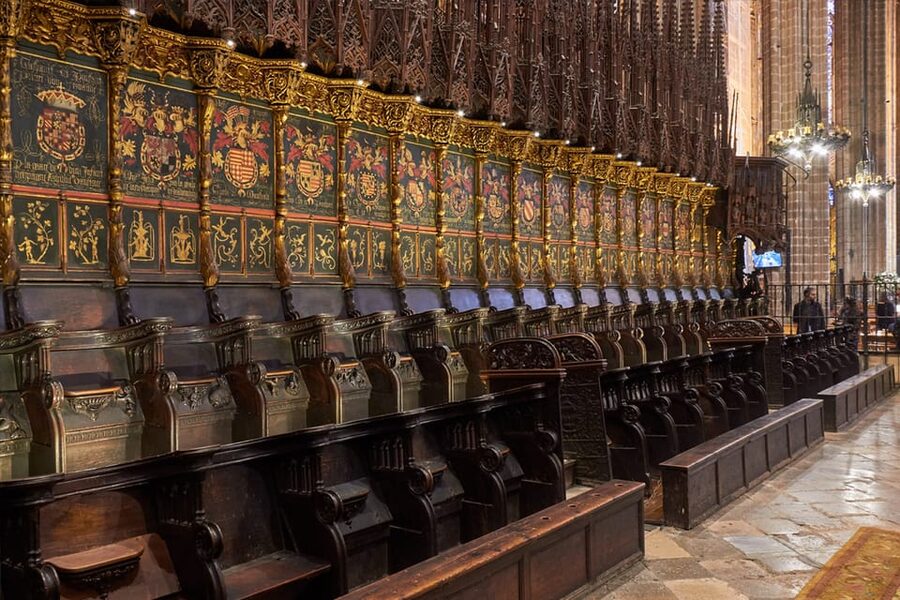
The main church is the grandest part of the building, with the height and form you expect from Gothic architecture. The scale can be impressive, but the visual appeal lies just as much in the smaller details as in the overall size.
Look along the side galleries and chapels for ornate additions, sculpture, and religious scenes. If you are not religious, you can still appreciate the craftsmanship and the way the building preserves centuries of artistic work.
The atmosphere can shift during your visit. This remains an active cathedral, so worship and quiet reflection are part of the setting. Mass may be taking place, and visitors need to keep noise low. That is worth remembering if your ideal sightseeing style involves constant narration or taking photographs at every turn.
The virtual audioguide is useful here because it lets you move at your own speed. It is available in Spanish, Catalan, English, German, Italian, and French. It also includes images, which can help you identify the details being discussed.
The audio experience is not a substitute for a live guide. You will not have someone answering questions or leading you from one point to the next. For many people, that is an advantage. You can stop listening, move on, or linger in a chapel without holding up a group.
Same city, a completely different evening:
- Barcelona: Casa Batlló Entry with Self-Audioguide Tour
★ 4.7 · 25,359 reviews - Barcelona: 24 or 48-Hour Hop-On Hop-Off Bus Tour
★ 4.4 · 20,872 reviews - Barcelona: Park Guell Guided Tour with Skip The Line Entry
★ 4.7 · 17,563 reviews - Barcelona in 1 Day: Sagrada Familia, Park Guell,Old Town & Pickup
★ 5.0 · 13,541 reviews
Taking the elevator to the rooftop
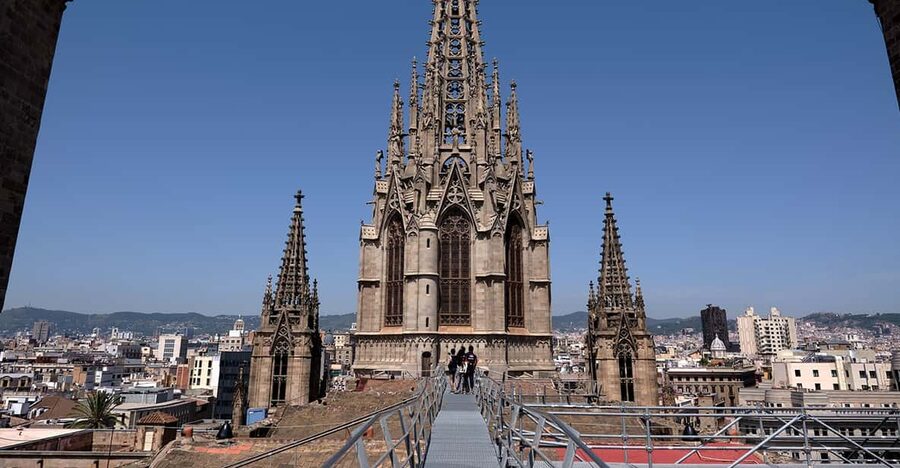
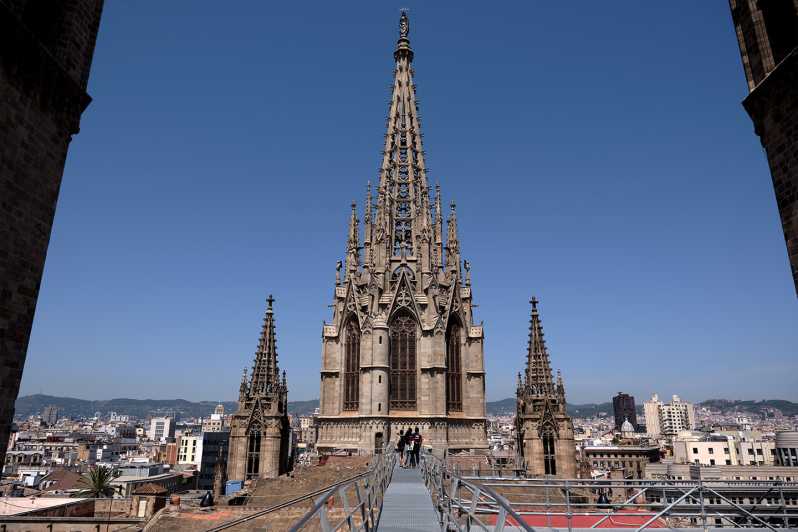
The rooftop is the clear payoff for many visitors. You reach it by elevator through the Chapel of the Innocent Saints, near the door of San Ivo.
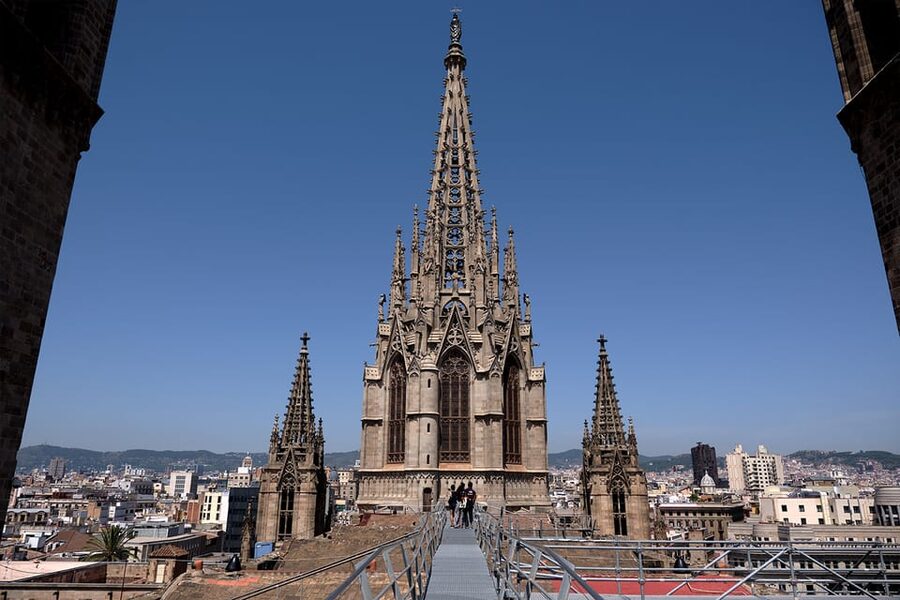
At the top, you see the cathedral from an angle that is impossible from street level. The two bell towers, lateral pinnacles, cloister, and central cimborio crowned by the Holy Cross come into view. The rooftop also opens onto broad views across Barcelona and the Gothic Quarter.
The city panorama is not a mountain viewpoint or a dramatic coastal lookout. It is an urban view, with rooftops, church towers, and the dense historic center spread around you. That makes it particularly useful for getting your bearings. You can connect the narrow streets below with the larger shape of the city.
Allow extra time for the elevator. The lift carries a maximum of eight people, and a 20 to 30 minute wait is possible. The line may be longer at busy times, so do not schedule the cathedral too tightly before another attraction.
The elevator is a real benefit for older visitors and anyone who does not want to tackle a steep tower stairway. It is also the main weakness of the rooftop arrangement. If the lift is out of service, the upper section may not be available to you. A broken elevator has prevented some visitors from seeing the tower, so treat the rooftop as an important possibility rather than an absolute guarantee.
Once you reach the roof, take your time. The viewing area is not enormous, but the architectural details are close at hand. You can study the bell towers and pinnacles, then turn outward for the city. Bring a camera, but keep it secondary to looking around. The rooftop is one of those places where a few minutes of quiet observation pays off.
The Chapter Hall museum and its older objects
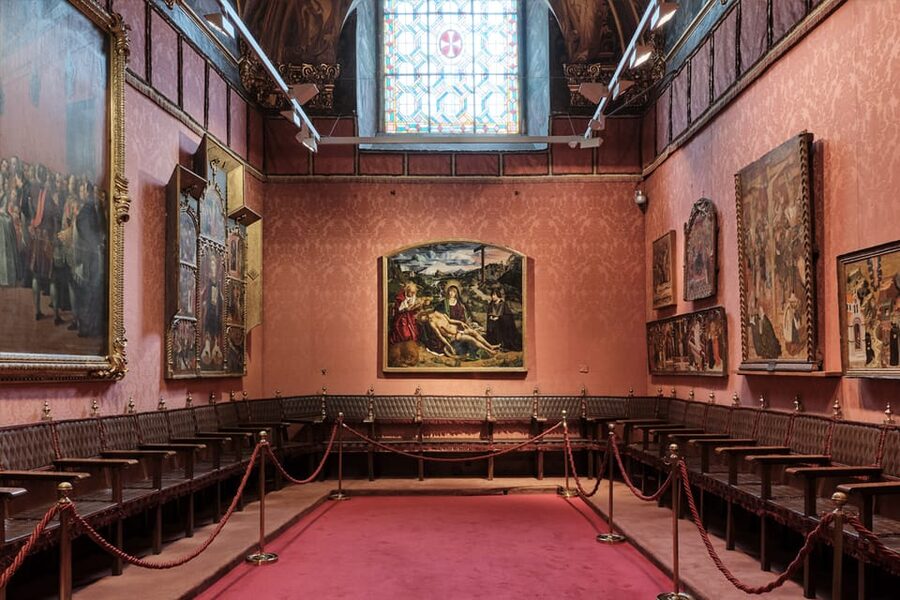
The Chapter Hall sits beneath the cloister gallery, beside the chapel dedicated to Saint Lucia. It began as a soup kitchen for poor people, which gives the room a social purpose beyond its religious role.
Today, it functions as a museum space. The collection described for this visit is compact, so do not expect a large art museum. Its strength is in a few specific objects tied closely to the cathedral.
The 11th-century lobed baptism font came from the former Romanesque temple. It helps connect the present Gothic cathedral with the earlier building on the site.
You will also see a terracotta sculpture of Saint Eulalia by Giuliano di Nofri. It originally came from the pediment above the door of Saint Eulalia. These are the kind of pieces that can be easy to skip if you are focused only on the main nave and rooftop, but they give the cathedral a longer timeline.
The Chapter Hall is especially useful after the cloister and roof. You have seen the building’s decoration and its city views; this room brings you back to its objects and earlier phases. Use the audio guide here if you want more explanation, since the ticket does not include a live tour.
The VR experience and self-guided format
A VR experience is included, along with the virtual audioguide. The information provided does not give a full description of the VR presentation, so you should think of it as an added digital feature rather than the main reason to buy the ticket.
The self-guided format suits independent visitors. You can spend more time in the garden, move quickly through a familiar section, or pause for photographs without following a schedule set by a guide.
The trade-off is that you must organize your own visit. There is no official guided tour included, and the cathedral has enough rooms, chapels, and architectural details to reward a little planning. Start with the cloister, see the interior, check the rooftop queue, and finish with the Chapter Hall if the timing works.
The digital guide has received strong praise for being clear and easy to follow. Still, technical problems can happen. Keep your ticket QR code ready, and do not assume the audio will work perfectly on every phone. If the guide fails, you can still see the building, but you will lose much of the historical explanation that adds value to a self-guided visit.
How long to allow and when to arrive
The stated visit time is one to two hours. I would allow the full two hours if you want to hear the audio, inspect the chapels, visit the garden, wait for the elevator, and spend time on the roof.
If you are mainly interested in architecture and photographs, you may finish in less than an hour, especially if there is no rooftop queue. The roof line is the part most likely to stretch your visit.
Pay close attention to the cathedral’s closing time on the day you select. One visit with a Saturday closing time of 4:30 p.m. required arriving by about 3 p.m. to allow enough time for the roof and VR experience. Hours can vary, so check the available starting times and plan to enter early rather than treating this as a last-minute stop.
The ticket is valid for one day. It is not refundable, so choose your date carefully before booking.
Dress rules, quiet behavior, and practical details
This is an active place of worship, not only a sightseeing attraction. Hats are not allowed, pets are not permitted except assistance dogs, and you need to keep noise low.
Cover your shoulders. A tasteful sleeveless outfit may still lead to a request for additional covering, and a shawl may cost extra at the entrance. This is an easy problem to avoid if you dress modestly from the start.
Comfortable clothing and water are sensible, particularly if you are visiting several sights in the Gothic Quarter on the same day. A camera is welcome, but be mindful of worshippers and any restricted areas.
Sant Sever Church is also included in the ticket. The available information does not give a detailed route or description for that church, so check the local instructions on arrival if you want to make sure you find it during the same day.
Who will get the most from this ticket
I would choose this ticket if you want to explore independently and care about both architecture and city views. It suits adults, older visitors who value elevator access, photographers, and anyone who prefers a flexible pace over a scheduled group tour.
It is also a good choice for a first visit to the Gothic Quarter because the rooftop helps you understand the area from above. The cloister garden adds a calmer, more personal side to the visit.
You may want to skip it if you only want a quick look inside a church, dislike waiting for lifts, or expect a full guided explanation from a local expert. The $23 price makes the most sense when you use the roof, audio guide, cloister, Chapter Hall, and included extras.
Should you book Barcelona Cathedral?
Book it if the rooftop and cloister appeal to you. The cathedral interior is beautiful, but the combination of rooftop views, garden, geese, and museum makes this more than a simple church entry.
Go early in your selected time window, cover your shoulders, and allow two hours. If the lift is working and the line is reasonable, the ticket offers solid value in one of Barcelona’s most atmospheric districts. If you want a live guide, this is not the right product, but independent visitors will find plenty to see and enough digital help to make the visit worthwhile.
FAQ
How much does the Barcelona Cathedral entry ticket cost?
The ticket costs $23 per person.
How long does the visit take?
The visit takes approximately one to two hours. You may finish sooner if you only see the main areas, but the rooftop queue can add time.
Is rooftop access included?
Yes. The ticket includes access to the cathedral rooftop, reached by elevator through the Chapel of the Innocent Saints.
Is a guided tour included?
No. A guided tour is not included. The ticket includes a virtual audioguide and a VR experience instead.
Which languages are available for the virtual audioguide?
The virtual audioguide is available in Spanish, Catalan, English, German, Italian, and French.
What can I see in the cloister?
You can see four galleries with ogive arches, carved reliefs, chapels, a garden with palms, magnolias and an orange tree, a fountain, and the pond with the cathedral’s white geese.
Are the geese really at the cathedral?
Yes. The cloister pond is home to 13 white geese.
What clothing rules apply?
Hats are not allowed, and you should cover your shoulders. Noise must be kept low, and see-through clothing is not permitted.
Is the ticket refundable?
No. This activity is non-refundable, so check your date and starting time carefully before booking.
Recently added in Barcelona
- Barcelona: Catamaran Cruise w/ Sailing, Wine, & Tapa★ 4.7 · 176 reviews
- Guided Gaudí Trencadís Mosaic Workshop in Barcelona 2 Hours★ 5.0 · 176 reviews
- Barcelona Cable Car Sky Views, Magic Fountain & Castle Visit★ 4.2 · 177 reviews
- Barcelona Private Sunset Sailing with Drinks★ 5.0 · 177 reviews
- Barcelona: Montserrat with Winery Visit and Farmhouse Lunch★ 4.7 · 178 reviews
- Barcelona: Nightmare Horror Museum Maze Entry Ticket★ 4.5 · 179 reviews
- Barcelona: City Sights Electric Quad Tour★ 4.8 · 178 reviews
- Barcelona: Professional Photoshoot Outside Sagrada Familia★ 4.8 · 179 reviews
Tickets, compared.
Sagrada Familia Entry Ticket with Audio Guide
Read the review →


Live Flamenco Dancing Show Ticket at the Theater
Read the review →