
Reviewed · WALKING TOURS
Private Half Day Walking Tour of Seville
Seville’s best-known sights unfold on foot in one compact route, from the golden Torre del Oro and the Giralda to the flower-filled lanes of Santa Cruz and the modern Setas. The tour brings together Islamic, royal, maritime, and literary Seville without asking you to manage the map.
I like the private format, since your guide can adjust the pace, explain a point again, or help with shade, bathrooms, and local shopping. I also like the strong storytelling focus. Carlos and Fernando are named guides, and the experience includes a professional guide with 30 years of experience. The main drawback is clear: nearly every major sight is viewed from outside, so entrance tickets and indoor time are not part of this tour.
Key points to know before booking
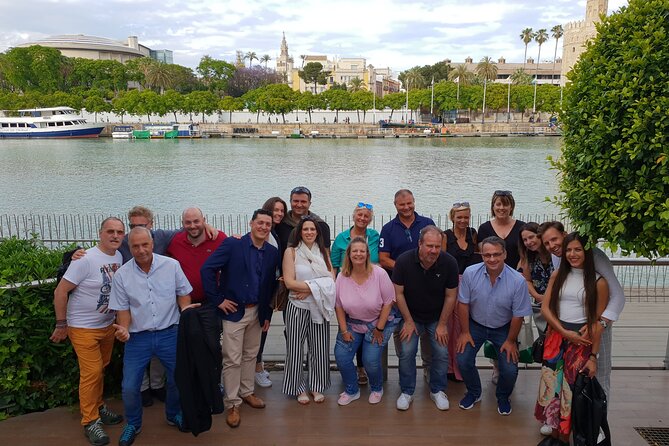
- Private walk from Puerta de Jerez to Plaza de San Francisco: Only your group takes part, with no strangers added to the booking.
- A long list of central sights in 2 to 3 hours: You cover the Cathedral, Giralda, Alcázar, Santa Cruz, Torre del Oro, City Hall, Calle Sierpes, and more.
- Carlos and Fernando are the named guides: Both are described as friendly, humorous storytellers with a strong command of Seville and Spanish history.
- Exterior visits keep the price and timing focused: You see the outside of the main monuments, but interior admission is not included.
- Game of Thrones and opera connections add color: The route links the Alcázar with Dorne and the Royal Shipyards with the series, while Santa Cruz recalls Carmen and The Barber of Seville.
- Free cancellation is available up to 24 hours ahead: Bad weather may lead to a new date or a full refund.
Why this route works for a first look at Seville

This is a sightseeing walk with a clear purpose: help you understand Seville’s center before you spend time inside its monuments or return on your own. The route begins at Puerta de Jerez, crosses the grand setting around the old riverfront, passes the Cathedral and Alcázar, then turns into Santa Cruz and the shopping core.
That order matters. You start with broad spaces and major buildings, then move into narrow lanes and small squares. By the end, you have a useful mental map of the old center, including the places where you may want to return for a longer visit.
The tour lasts about two to three hours. That is enough time for orientation and stories, but not enough for relaxed interior visits. You should expect a steady walk with many stops for explanation and photographs. A moderate level of fitness is requested, and comfortable shoes make sense.
The price is $133.03 per person, with group discounts available. For one or two people, that is not a bargain sightseeing walk. For a family or small group, the private setup may make the cost more reasonable, especially if you value a guide who can shape the talk around your interests. Tour photos are included, which is a pleasant extra, though the real value is the guide’s time and local context.
More Walking Tours in Seville
- Seville: Small-Group City Highlights Walking Tour
★ 5.0 · 1,204 reviews - Cultural Walking Tour of Seville Monumental
★ 5.0 · 861 reviews - Seville: Tapas, Taverns, and History Walking Tour
★ 4.9 · 676 reviews
Puerta de Jerez and Seville’s grand southern gateway
Meet at Puerta de Jerez, one of the old entrances to Seville. This is a fitting starting point because the area gathers several different chapters of the city in one view.
The exterior of the Hotel Alfonso XIII recalls the 1929 Ibero-American Exposition. Nearby, Palacio de San Telmo, the old Tobacco Factory, and the Torre del Oro create a quick lesson in Seville’s royal, industrial, and maritime past.
You will not enter the hotel or the palace on this walk. Instead, your guide uses the buildings around the square to explain how Seville presented itself to the world in the early 20th century and how its older institutions shaped the city.
This opening section also gives your group room to settle into the pace. If the day is hot, the guide’s ability to respond to your needs matters. Fernando is specifically praised for helping with shade, bathrooms, and local shopping, useful touches on a warm day.
The Tobacco Factory, San Telmo, and the river
The old Royal Tobacco Factory is one of the route’s most striking buildings. It is described as the largest building in Spain after the Escorial and now houses the Rectorate of the University of Seville.
The building also carries a literary and musical connection. It was the setting associated with Carmen, George Bizet’s opera about the cigarette-maker. You see the exterior, but the building’s scale and story make this more than a quick photo stop.
Next comes Palacio de San Telmo. It began as a school for navigators during the age of Atlantic exploration and later served as a residence for the Spanish royal family. Its garden is now part of Maria Luisa Park, a major legacy of the 1929 exposition.
This is one place where a good guide earns the fee. The buildings are easy to photograph on your own, but their changing roles are less obvious. Carlos is described as a strong storyteller with a good sense of humor, while Fernando is praised for making Spanish history clear and engaging. Those qualities suit a route packed with dates, names, and political shifts.
At the Torre del Oro, you see a 13th-century Islamic structure from the outside. Its location by the river reflects Seville’s old role in maritime traffic. The tower is one of the city’s most recognizable forms, and the guide connects it to the movement of ships, goods, and power through Seville.
Old gates, shipyards, and a quiet square
The Postigo Arch is another preserved entrance through the old city walls. The stop is brief in physical terms, but it helps you picture Seville as a fortified city rather than simply a collection of monuments.
Nearby are the Royal Shipyards, where ships bound for America were built. The site also served as a filming location for Game of Thrones. The television link will appeal to fans, but the shipbuilding story is the stronger reason to pay attention. It ties the city’s architecture to practical work and overseas expansion.
The route then reaches Plaza del Cabildo, one of Seville’s more unusual squares. Canons from the Cathedral once lived here, and an antiques market is still held on Sundays. This is the kind of stop that benefits from a guide because it is easy to miss when you are walking between larger attractions.
Do not expect a long market visit or a special shopping session. The value is in seeing how a quieter architectural corner fits into the city center.
Same city, a completely different evening:
- Seville: Royal Alcázar Entry Ticket
★ 4.6 · 28,378 reviews - Seville: Cathedral and La Giralda Entry Ticket
★ 4.5 · 24,592 reviews - Seville: Live Flamenco Dancing Show Ticket at the Theater
★ 4.7 · 16,396 reviews - Seville: Casa de la Memoria Flamenco Show
★ 4.8 · 12,964 reviews
The Cathedral, Giralda, and Archive of the Indies
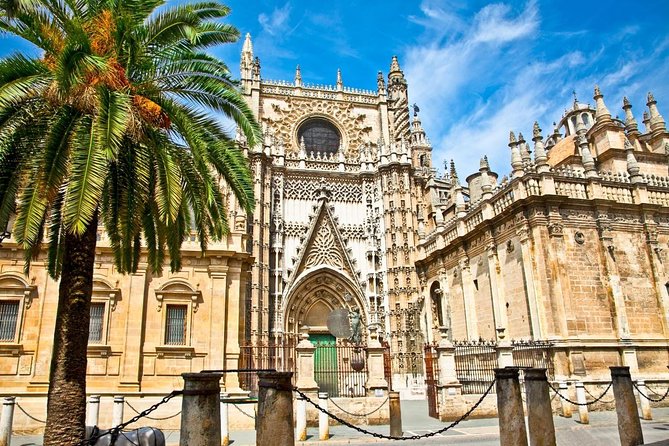
The exterior of Seville Cathedral is the visual center of the tour. It is recognized as the world’s largest Gothic temple and became a UNESCO World Heritage Site in 1987.
The building began as Seville’s main mosque, and its Islamic past remains part of its identity. The Giralda was first built as an Islamic minaret and later converted into the Cathedral’s bell tower. That change is central to understanding Seville, where different religious and political periods are layered into one building.
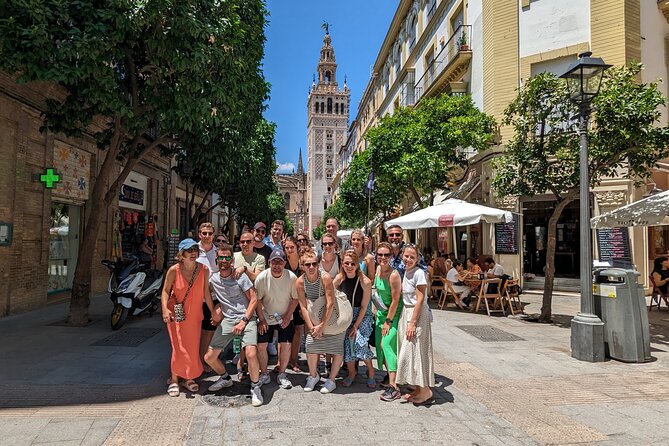
The tour includes two views of the Giralda, first as part of the Cathedral setting and later as a separate exterior stop. This may sound repetitive, but the tower looks different from different streets, and your guide can explain its role as Seville’s symbol.
Across from the Cathedral, the General Archive of the Indies holds more than 40,000 documents connected with the Americas. The collection includes maps, the Treaty of Tordesillas, and handwritten texts by Christopher Columbus. You see the exterior here, not the archive rooms or documents themselves.
That distinction is important. If you want to study the Cathedral, climb the Giralda, or view the archive’s holdings, you will need separate admission and extra time. This walk gives you the story and the street setting, then lets you decide what deserves a return visit.
The Alcázar walls and the Santa Cruz maze
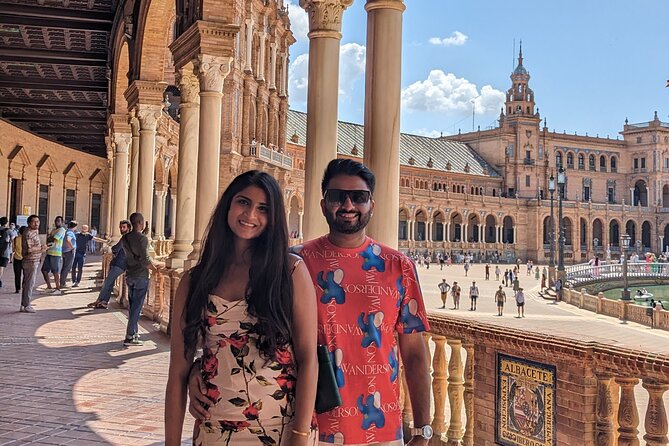
The exterior of the Real Alcázar comes next. It is a UNESCO World Heritage Site and the oldest royal palace in Europe still in use. The guide explains the kings connected with the palace and points out its Game of Thrones link, particularly the setting used for Dorne.
Again, the outside-only format is both useful and limiting. You get the palace walls and the broad story, but not the courtyards, gardens, or interiors that make the Alcázar one of Seville’s major paid sights. If the palace is a priority, reserve separate entry for another time.
From there, the route enters Barrio de Santa Cruz, Seville’s old Jewish Quarter and one of the city’s most picturesque areas. This is where the walk becomes less about grand façades and more about scale, shade, corners, and small details.
You pass Plaza de Doña Elvira, Plaza de los Venerables, Agua y Vida, and Plaza de Santa Cruz. The lanes are lined with patios, flowers, and whitewashed walls. The neighborhood also appears in opera, including The Barber of Seville.
This is the section where I would want a personable guide. Santa Cruz can feel like a maze, and a map does not tell you why a square has its name or how the quarter changed over time. Carlos is described as warm and entertaining, with the easy manner of a favorite older relative. That sort of personal delivery can make the narrow streets feel less like a checklist.
City Hall, El Salvador, and the modern Setas
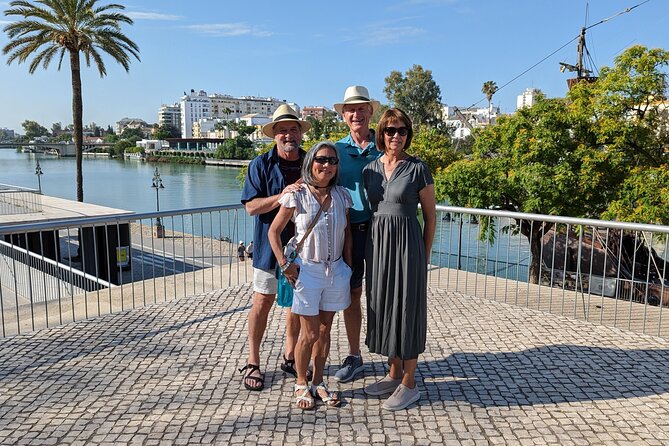
The walk continues to Seville City Hall, built in the 16th century during the reign of Emperor Charles V. Its Renaissance exterior reflects the city’s wealth when Seville was a major gateway to the Americas.
From there, you see the exterior of the Church of El Salvador. The site began as Seville’s first mosque in the 9th century and became a collegiate church in the 13th century under Ferdinand III. Its old ablution courtyard survives, a small but meaningful trace of the earlier Islamic building.
The setting around El Salvador also shows how religious buildings sit within the commercial heart of the city. Shops fill the surrounding streets, much as commercial activity once surrounded the mosque in the old medina.
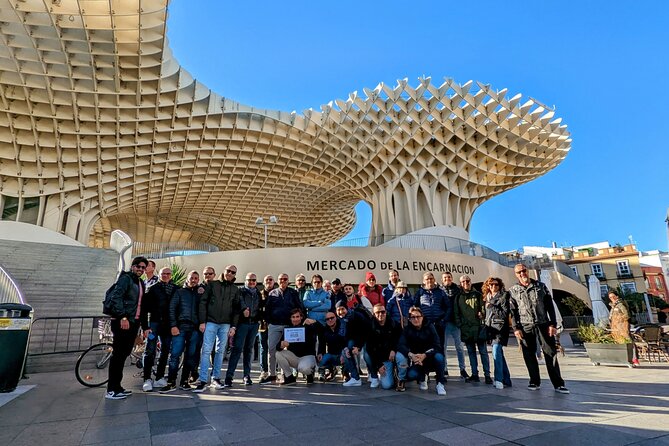
The route then passes through former Islamic-medina streets toward Plaza de la Encarnación and the Setas de Sevilla, also called Metropol Parasol. These large wooden structures by German architect Jürgen Mayer are among Seville’s most modern landmarks.
The Setas provide a useful contrast after so much Gothic, Islamic, Renaissance, and royal architecture. You see how Seville continues to add bold new forms to an old city. The tour does not list interior access or rooftop admission, so treat this as an exterior viewing stop.
Calle Sierpes and the finish at San Francisco
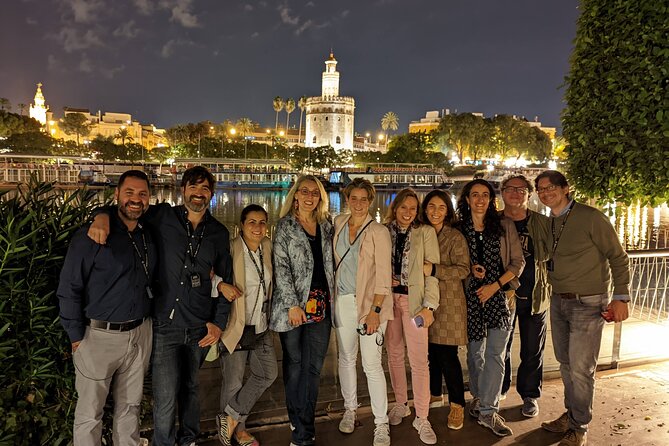
Calle Sierpes is one of Seville’s best-known shopping streets. It runs through the center and is lined with shops and cafés. The route also points out the old Royal Prison, associated with Miguel de Cervantes.
This part of the walk shifts from monumental sightseeing to everyday city life. You see where people shop, eat, and move through the center. It is a good place to ask your guide for practical suggestions, especially if you want to continue on your own after the tour.
The final stop is Plaza de San Francisco, close to City Hall, the Cathedral, and the center of Seville. Ending here is practical. You are not left on the edge of town, and you can continue shopping, find a café, return to the Cathedral area, or walk back toward Santa Cruz.
What the private guide adds
The guide is the heart of this experience. Carlos and Fernando are the named guides, and the tour is presented with an official professional guide from Seville who has 30 years of experience.
The strongest qualities associated with the guiding are clear: detailed history, humor, storytelling, and personal attention. Carlos is described as friendly and especially good at making a family feel comfortable. Fernando is praised for explaining the city and Spain while responding to practical needs during summer heat.
That matters because the route contains a lot of material. You move from Islamic architecture to the Spanish monarchy, from Atlantic trade to opera, and from Cervantes to Game of Thrones. A flat list of facts would be tiring. A guide who links the stories makes the walk easier to follow.
Since the tour is private, only your group participates. You can ask questions without worrying about holding up a large crowd. The tradeoff is price. At $133.03 per person, the walk makes the most financial sense for a group that wants a personal introduction rather than the lowest-cost way to see landmarks.
Timing, comfort, and what is not included
The meeting point is Puerta de Jerez, and the walk ends at Plaza de San Francisco. Private transportation is not included, but the route connects central sights on foot and begins near public transportation.
Plan for a moderate physical effort. You will cover several neighborhoods in two to three hours, with standing at monuments and walking along old streets. The tour requires good weather, and poor conditions can lead to a different date or a full refund.
English is offered, and you receive confirmation at booking. Service animals are allowed. Free cancellation is available until 24 hours before the start time, while changes or cancellations inside that window are not accepted.
The biggest planning point is the exterior-only approach. You see the Cathedral, Giralda, Alcázar, Archive of the Indies, Royal Shipyards, Tobacco Factory, and other major buildings from outside. Admission, interior touring, and private transportation are not included.
Who should book this Seville walking tour?
I would choose this for a first day in Seville, especially if you want a fast but informed orientation. It also suits families and small groups who prefer to ask questions, set their own pace, and avoid joining a large public tour.
It is a good fit for architecture fans, opera lovers, history students, and Game of Thrones followers. The mix of Carmen, The Barber of Seville, Dorne, Atlantic exploration, and Islamic architecture gives different interests a way into the city.
I would be less likely to book it if my main goal were long interior visits. You need a separate plan for the Cathedral, Giralda, Alcázar, and Archive of the Indies. This experience helps you decide what to visit, but it does not replace those visits.
Should you book it?
Book this tour if you want a private, story-led orientation to Seville and value a guide who can connect major sights with local history. Carlos and Fernando bring the personal touch that can make a tightly timed walk feel relaxed and human.
Skip it if you want the cheapest introduction or expect included entry to the Cathedral and Alcázar. For everyone else, the route is well chosen, the finish is central, the guide can adapt to your group, and the walk gives you a solid sense of how Seville’s many eras fit together.
FAQ
How long does the private Seville walking tour last?
The tour lasts approximately two to three hours.
Where does the tour begin?
The meeting point is Puerta de Jerez in Seville’s Casco Antiguo.
Where does the tour end?
The walk finishes at Plaza de San Francisco, near City Hall, the Cathedral, and the center of Seville.
Is this a private tour?
Yes. Only your group participates in the private tour or activity.
Are admission tickets included?
No. The itinerary describes exterior visits to the Cathedral, Giralda, Alcázar, Archive of the Indies, Tobacco Factory, Royal Shipyards, and other sights. Entry tickets are not listed as included.
Is transportation included?
No. Private transportation is not included. The experience takes place as a walking tour and begins near public transportation.
Can I cancel for a full refund?
Yes. You can cancel at least 24 hours before the experience start time for a full refund. If poor weather causes cancellation, you will be offered another date or a full refund.
Recently added in Seville
- Seville: 3–Hour Sightseeing Tour★ 4.4 · 101 reviews
- Gibraltar with Rock of Gibraltar & St. Michael Cave from Seville★ 4.5 · 102 reviews
- Alcazar, Cathedral and Giralda of Seville with entrance fee included★ 4.0 · 102 reviews
- Seville: Archive of the Indies Guided Tour★ 4.6 · 102 reviews
- Seville Jewish Quarter walking tour: Santa Cruz District★ 4.8 · 104 reviews
- Seville Former Jewish Quarter Walking Tour: Santa Cruz★ 5.0 · 105 reviews
- Seville: Museum of Fine Arts Guided Tour★ 4.8 · 107 reviews
- Seville: 3 Bars Pub Crawl + VIP Club Entrance & 3 Free Shots★ 4.3 · 108 reviews
Walking Tours, compared.

Barcelona Tapas and Wine Experience Small-Group Walking Tour
Read the review →
Tapas Walking Tour with Food, Wine, and History
Read the review →
Albaicín and Sacromonte Guided Sunset Walking Tour
Read the review →
Toledo Tour & Vineyard Walk with Wine Tasting from Madrid
Read the review →

Barcelona Tapas Walking Tour: Food, Wine & History
Read the review →
Madrid Old Town & Royal Palace Walking Tour Skip the Line Ticket
Read the review →
Browse the lists this tour appears in