
Reviewed · MADRID TOURS
Spanish Civil War start of 2 World War, Guernica Franco
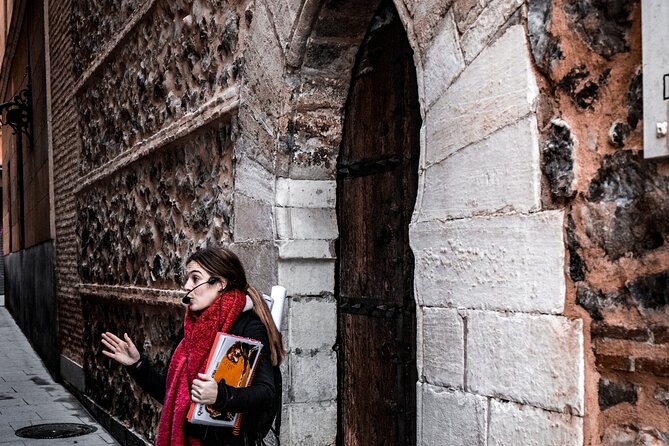
Madrid’s Civil War story comes alive on this walk through streets where air raids, barricades, propaganda, and political fear shaped daily life. You move from central Madrid to Moncloa, tracing the war from its causes to Franco’s victory and the dictatorship that followed. Guernica, the defense of the capital, and the war’s link to World War II all have a place.
I like the route’s clear seven-stop structure, which gives you a firm timeline instead of a loose collection of monuments. I also like the use of maps, images, audio, and video, since Madrid’s wartime scars are not always easy to spot with the naked eye.
The main consideration is pace. The walk lasts about two and a half hours, covers several parts of the city, and includes a fair amount of serious material. The advertised group size also varies in the details, so confirm whether your departure allows up to 15 or as many as 30 people.
Key points to know before you go
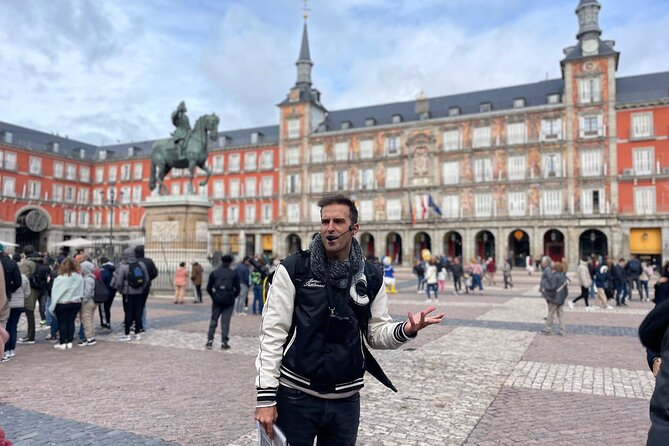
- Madrid becomes the classroom: The route connects ordinary streets, military buildings, public squares, and monuments to the war.
- The tour covers causes as well as battles: You learn why Spain split, not just where fighting took place.
- Guernica receives useful context: Picasso’s painting is linked to the bombing of civilians and the international meaning of the war.
- The experience reaches beyond 1939: The final stops explain how the war led into World War II and Franco’s dictatorship.
- Visual material helps: Maps, photographs, audio, and video make vanished scenes easier to understand.
- Several guides lead the experience: Victor, Maikel, Guillermo, Adria, and Chato are named guides associated with this route.
Why this Madrid walk matters
Many Madrid sightseeing walks focus on royal buildings, grand avenues, and food. This one asks you to look at the city through a harder lens: What happens when politics breaks a country in two, and what does war feel like for people who still have to shop, work, sleep, and decide if going to the cinema is safe?
That question gives the experience its strongest feature. You are not simply shown monuments. You are given a way to read the city. The guide uses historical material to connect places with choices made by soldiers, politicians, artists, and civilians.
The subject is also larger than Spain. The Spanish Civil War became a testing ground for military tactics, propaganda, foreign support, and attacks on civilians. By the end, the walk links Madrid’s war to World War II and to the long dictatorship that followed under Francisco Franco.
I would choose this tour early in a Madrid visit if you want political and social context for the city. It can change how you see familiar places later, especially central squares and the broad avenues around Moncloa.
A few other Madrid outings to compare
- Madrid: Tour Bernabéu Entry Ticket
★ 4.5 · 21,573 reviews - Madrid: Prado Museum Entry Ticket
★ 4.6 · 17,509 reviews - Madrid: Royal Palace Fast-Access Admission Ticket
★ 4.6 · 13,856 reviews
Plaza del Callao and the war in central Madrid
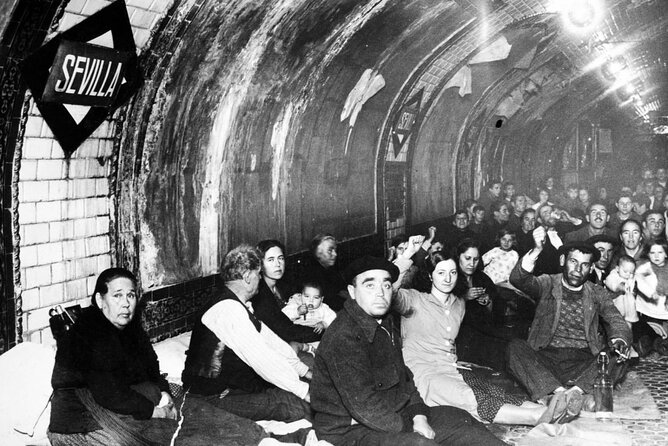
The walk begins at Plaza del Callao, in the center of Madrid. It is an energetic commercial area today, filled with shops, cinemas, and busy streets. That makes it a useful place to begin a story about wartime Madrid, because the modern scene can hide the fact that central buildings were exposed to bombing.
Here you look for scars left on buildings and discuss air raids in the city center. The stop also turns toward civilian life. The question of whether an ordinary Spaniard would go to the movies during wartime is more revealing than a list of military dates. It points to fear, routine, boredom, and the effort to keep daily life going.
The scheduled visit lasts about 15 minutes. That is enough for an introduction, but not a long architectural survey. Listen for the guide’s explanation of what remains visible and what has disappeared. The maps and images supplied during the tour are especially useful here, since wartime damage may not be obvious from the street.
Palacio del Senado and the split between two Spains
At the Palacio del Senado, the subject shifts from the visible effects of bombing to the causes of the conflict. The key question is how the Spanish Civil War began and why the country became divided.
This is where the tour needs to explain more than the simple label of fascists against republicans. The walk addresses two divided Spains, including the political forces and social tensions that made compromise difficult. It also presents Spain as a testing ground before World War II, a place where outside powers could watch, assist, experiment, and learn.
The stop lasts about 20 minutes. That timing matters. You get a proper explanation of the opening crisis, but the guide must keep the story moving. If you already have a strong background in Spanish politics, you may want to ask questions during the stop. If you are starting from zero, the visual aids should help you keep the main groups and events straight.
This is one of the most valuable parts for first-time learners. Without it, the later discussion of Franco, propaganda, and the siege of Madrid can feel like disconnected facts.
Plaza de España and Madrid’s 900-day defense
Plaza de España introduces Francisco Franco and the defense of the capital. Madrid endured about 900 days of siege, and the tour uses that long ordeal to explain what it meant for the city to remain under pressure.
The stop includes Madrid under bombs and wartime sayings. That combination is important. Military history tells you where forces moved, but sayings and everyday language can show how people tried to make sense of danger. A short phrase can reveal public mood, political loyalty, or a dry joke made under terrible conditions.
The guide also places Franco within the story rather than treating him as an isolated figure. You learn how the war’s leadership and final outcome shaped Spain for decades.
This is another 15-minute stop, so expect a focused account rather than every detail of the siege. Plaza de España is a public urban setting, not a museum room. You may encounter normal city activity around you, which can make concentration harder, but it also keeps the story connected to the living city.
Same city, a completely different evening:
- Madrid: “Emociones” Live Flamenco Performance
★ 4.8 · 12,866 reviews - Madrid: Panoramic Route City Tour
★ 4.1 · 12,259 reviews - Madrid: Live Flamenco Show with Food and Drinks Options
★ 4.5 · 9,901 reviews - Avila & Segovia Tour with Tickets to Monuments from Madrid
★ 5.0 · 9,762 reviews
Templo de Debod, money, propaganda, and memory
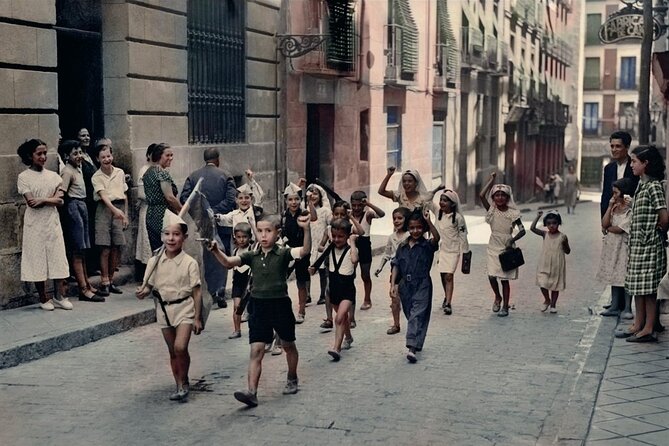
The route continues to the Templo de Debod, where the subject broadens to the forces that kept the war going. The discussion asks who paid for the conflict and how money, arms, and foreign backing affected the balance.
The stop also examines propaganda as a war of ideas. This is a strong fit for a walking tour because propaganda was not limited to newspapers. Political messages appeared in posters, speeches, songs, symbols, and public ceremonies. The supplied images and videos can make that part of the story more concrete than a spoken lecture alone.
The Templo de Debod itself adds an unexpected setting. The Egyptian temple is not a Civil War site, but it provides a recognizable Madrid landmark and a pause in the route. Nearby, the tour addresses a sculpture dedicated to those who died in the Civil War.
That pairing creates a useful contrast. One monument carries a much older story from outside Spain, while the sculpture asks Madrid to remember its own modern dead. The stop is scheduled for about 20 minutes.
You should not expect entry into the temple or any other paid site. The experience is built around outdoor locations, and no admission tickets are needed. Wear comfortable shoes and be ready to remain standing while the guide explains the material.
Paseo del Pintor Rosales and the meaning of Guernica
Paseo del Pintor Rosales is the most art-focused section of the walk. Here you discuss Picasso’s Guernica and the bombing of civilians.
The value is not that the tour takes you to the painting itself. Instead, it explains how the bombing of Guernica became a symbol of modern warfare and civilian suffering. Picasso’s work carries power partly because it turned a specific attack into an image understood far beyond Spain.
The stop also brings in the Prado Museum and art under fire. That topic shows that cultural institutions faced wartime choices too. Paintings and national treasures had to be protected while the city was under attack. The war affected not only homes and streets, but also the objects a country used to define itself.
A final theme here is Christmas during a truce, described as a brief breathing space. It is a small human detail in a large conflict. Moments of pause do not erase the violence, but they show how people sometimes created temporary room for family, ritual, or simple relief.
Plan on about 20 minutes. If you want to see Guernica at the Reina Sofía, this walk can provide helpful preparation, but the tour does not include museum admission. Treat the stop as historical and interpretive context, not as a gallery visit.
Cuartel General del Ejército del Aire and the road to dictatorship
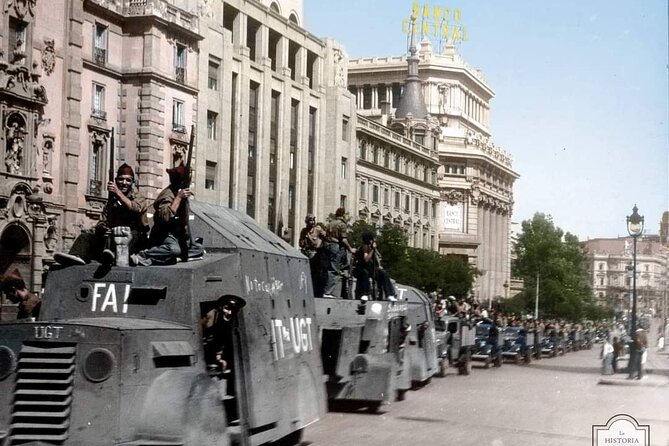
At the Cuartel General del Ejército del Aire, the story turns to music, medicine, and the war’s final phase. The reference to They Won’t Happen and Cara al Sol introduces songs tied to the period and to political identity. Music can carry ideology in a direct way, especially when people sing together in public or under military authority.
The stop also covers the first remote blood transfusion. That subject brings medical innovation into the story. A transfusion is not just a technical achievement here. It represents the attempt to save life in conditions where hospitals, roads, supplies, and medical staff were under extreme strain.
The final point is crucial: the end of the Civil War did not mean a return to normal life. The outcome led into World War II and to Franco’s dictatorship. Spain did not simply close one chapter and begin a peaceful new one. Political repression and the consequences of defeat continued long after the fighting stopped.
This stop lasts about 15 minutes. The mix of music, medicine, and politics is unusual and gives the walk a human scale. It also asks you to hold several ideas at once, so this is a good place to ask the guide to clarify anything that remains unclear.
The Victory Arch and an unresolved monument
The final stop is the Victory Arch, or Arco de la Victoria, near Moncloa. The monument was built to celebrate the Nationalist victory, which makes it an uncomfortable but important ending.
The key question is whether such a monument should be destroyed, preserved, or interpreted. That is not an abstract issue in Madrid. A victory arch can honor one side while reminding others of defeat, imprisonment, exile, or political silence.
The guide uses the arch to reflect on war memorials and the way cities handle painful public memory. This gives the walk a thoughtful finish rather than a simple ending at Franco’s victory.
The tour ends at Arco de Moncloa, on Avenida de la Memoria, near Metro Moncloa. The location is useful if you plan to continue exploring western Madrid or need a clear transport connection after the walk. It is also a practical point to remember when planning your day, since the tour finishes away from its central starting point.
Guides, group size, and the feel of the walk
The named guides connected with this experience include Victor, Maikel, Guillermo, Adria, and Chato. The strongest qualities to look for are clarity, warmth, and sensitivity. This is a subject that can easily become dry, partisan, or overwhelming. The guide needs to explain competing political positions without turning the walk into a political argument.
Chato is noted for giving extra time and extending the session beyond the planned two hours and 30 minutes. That can be welcome if you want more detail, though you should not assume every departure will run long.
The published capacity is not fully consistent: one detail describes groups of up to 15, while another gives a maximum of 30. Ask for the group size before booking if a quieter experience matters to you. A small group makes it easier to ask questions and see visual material. A larger group may feel less personal, especially at busy public squares.
The tour is offered in English and uses a mobile ticket. Service animals are allowed, and the route is near public transportation. Most people can participate, but the walk involves several outdoor stops and standing, so comfortable footwear is sensible.
Is $3.62 a good value?
At the stated price of $3.62 per group, up to the stated group limit, the value is unusually strong. You are getting a local guide, a 2.5-hour route, historical maps, images, audio, videos, and a link to personalized Madrid suggestions. No site entry fees are needed because the experience is based on public locations.
Still, check the final price carefully before paying. A figure this low may depend on the exact booking conditions, group size, or platform display. If the amount truly applies to your whole group, it is far cheaper than most guided city experiences.
The value also depends on your interests. If you want shopping, food, or grand interiors, this is not the best use of two and a half hours. If you want to understand Madrid’s political past and see the city through that story, the combination of guidance and visual material gives you a lot for the time.
Tips are not included. They are optional, but a tip is a reasonable way to recognize a guide who adds time, handles sensitive subjects well, or gives useful personal advice after the walk.
Who should book this experience?
I would book it if you want a serious but approachable introduction to the Spanish Civil War. It suits adults, students, history readers, museum visitors, and anyone who wants to understand why Franco and the Civil War still matter in Spain.
It is also useful if you plan to visit the Reina Sofía and see Guernica. The tour will not replace the museum, but it can give the painting a clearer political and human setting.
I would think twice if you have only one short day in Madrid and prefer the city’s art, food, or royal sights. The route is focused, emotionally heavy, and spread across several locations. You also need to be comfortable listening closely in public spaces.
The tour has earned a five-star rating from 462 submitted ratings, with 100 percent recommending it. More important than the number is the pattern in the praise: guides are repeatedly described as clear, friendly, authentic, passionate, and able to make difficult material engaging. Those are exactly the traits you want for this subject.
Should you book the Madrid Civil War walking tour?
Book it if Madrid’s twentieth-century story interests you, especially if you want more than dates and battle names. The route gives you causes, civilian life, propaganda, art, medicine, Franco, and the long shadow of dictatorship in one well-planned walk.
The best reason to choose it is the way the stops build on one another. Plaza del Callao introduces the civilian experience, the Senate explains the split, Plaza de España covers the siege, Templo de Debod looks at funding and memory, Paseo del Pintor Rosales connects war to art, and the Victory Arch leaves you with the problem of public remembrance.
Confirm the group limit and final price before booking. If those details work for you, this is a low-cost, high-content way to read Madrid with sharper eyes.
FAQ
Where does the tour begin?
It begins at C. del Postigo de San Martín, 26, Centro, 28013 Madrid, Spain.
Where does the tour end?
It ends at the Victory Arch, or Arco de Moncloa, at Avenida de la Memoria, 32, Moncloa-Aravaca, 28040 Madrid. Metro Moncloa is nearby.
How long does the experience last?
The advertised duration is approximately two hours and 30 minutes.
Is the tour offered in English?
Yes. English is the stated language for the experience.
Are tickets to the sites included?
No entry tickets are needed. The tour takes place at outdoor public locations, and site admissions are not included.
What does the tour provide besides a guide?
The experience includes maps, images, audio, videos, personalized Madrid recommendations, and continued personalized attention from the guide after the tour.
How many people can join?
The details state both up to 15 people per group and a maximum of 30 participants. Confirm the applicable group size when booking.
Can I cancel for a full refund?
Yes. You can cancel at least 24 hours before the local start time for a full refund. Cancellations or changes made less than 24 hours before the start time are not accepted for a refund.
Recently added in Madrid
- Entrance to the Flamenco Temple Room in Madrid with Tapas Option★ 5.0 · 176 reviews
- Tapas & Paella Cooking Class in Madrid with a Professional Chef★ 5.0 · 177 reviews
- Madrid: Toledo Day Trip with Winery Visit and Wine Tasting★ 4.4 · 177 reviews
- VIP visit to the Las Ventas Bullring in Madrid★ 5.0 · 178 reviews
- VIP Entrance Ticket to Our Secret Alley in Madrid★ 5.0 · 179 reviews
- Madrid: Prado & Reina Sofía Museums Guided Tour★ 4.5 · 180 reviews
- Madrid: Royal Palace tour – semi private or private★ 4.9 · 182 reviews
- Atletico de Madrid Stadium & Interactive Museum Admission Ticket★ 4.5 · 183 reviews
Madrid Tours, compared.
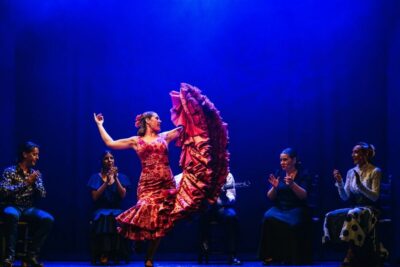
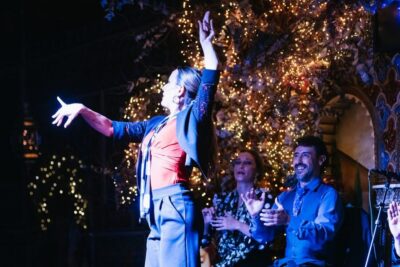
Live Flamenco Show with Food and Drinks Options
Read the review →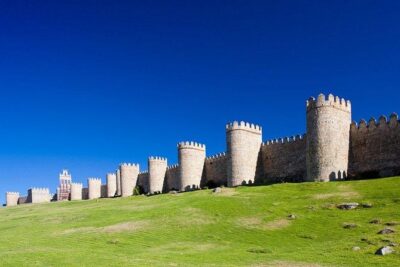
Avila & Segovia Tour with Tickets to Monuments from Madrid
Read the review →
Three Cities in One Day: Segovia, Avila and Toledo from Madrid
Read the review →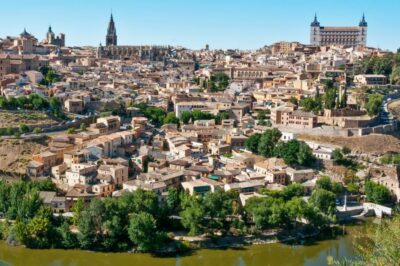
Segovia and Toledo Tour, Alcazar, and Cathedral
Read the review →
Royal Palace Expert Guided Tour with Skip-the-Line
Read the review →Browse the lists this tour appears in