Reviewed · GUIDED
Palau de la Musica Catalana Guided Tour
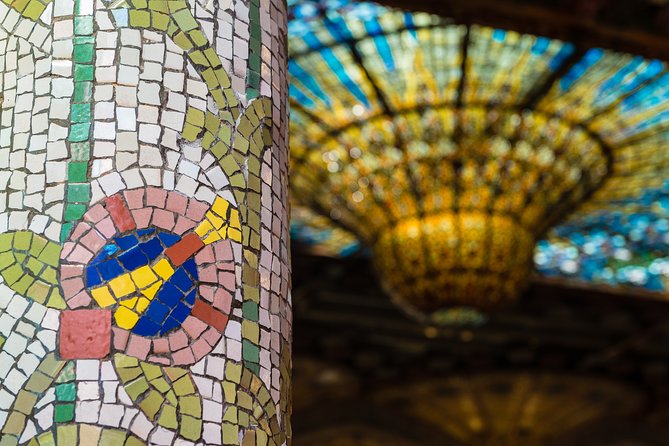
The most astonishing thing about the Palau de la Música Catalana is that the concert hall feels less like a formal theater and more like a jewel box built for music. Stained glass, mosaics, sculptures, flower-covered columns, and a huge inverted dome compete for your attention. The Concert Hall is the star, but the staircases and Lluís Millet Hall reward a slower look.
I like the small group of no more than 15 people, which makes it easier to hear the guide and study details without being swept along in a crowd. I also like the 15-minute film at the start. It gives you a quick sense of the building’s purpose and its place in early 20th-century Catalonia before you begin looking at the decoration.
The tour lasts about an hour, so it fits neatly between other Barcelona plans. The main consideration is that the visit can feel rushed if your guide speaks quickly or if you want lots of time for photographs. A few visitors also found the tour ended slightly early, and the meeting instructions can be a little unclear.
Key points to know before you book
- The Concert Hall is the main event: Look up at the stained-glass arches and inverted dome, then turn toward the stage sculptures and organ.
- A 15-minute film comes first: The opening clip explains the building’s construction and the society that shaped it.
- The staircases deserve attention: Their undersides carry elaborate tiles, while glass balusters support the marble banisters.
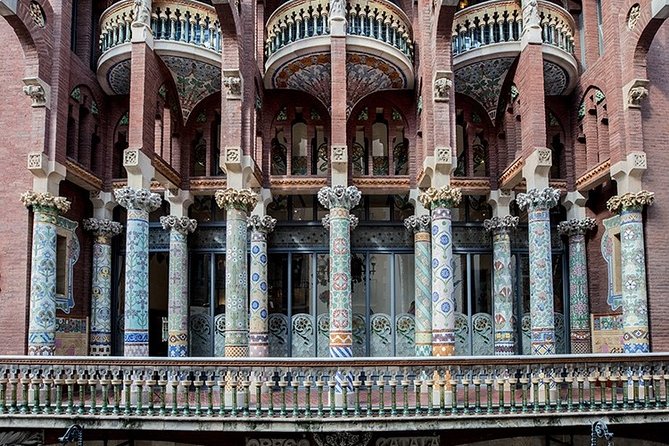
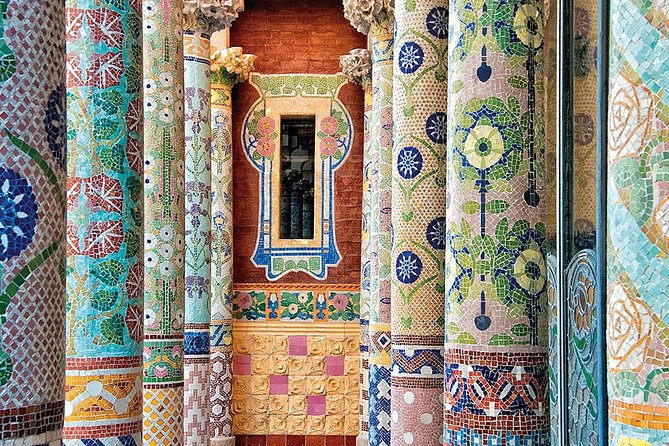
- You visit the Lluís Millet Hall: Floor-to-ceiling windows open toward the main façade’s mosaic-covered columns.
- You get a guide, not just an audio recording: The guide explains the architects, artists, symbols, and acoustics.
- It is a compact visit: Plan on about one hour, with admission and a mobile ticket included.
Why the Palau de la Música Catalana is worth your time
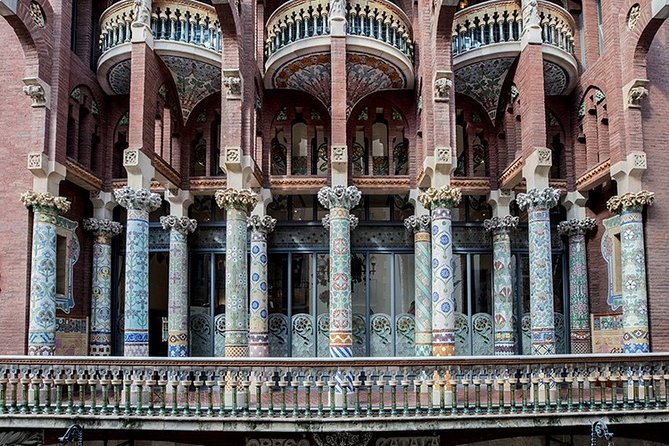
Barcelona gives you no shortage of famous architecture. Antoni Gaudí gets much of the attention, but the Palau de la Música Catalana offers a different lesson in Catalan modernism. The building was designed for the Orfeó Català choral society, and its decoration treats music, nature, and Catalan identity as one connected idea.
That matters because the Palau is not simply a pretty concert venue. Every surface has a job. Light enters through stained glass. Flowers climb across mosaics. Sculptures frame the stage. The hall’s design also serves singers and orchestras, rather than acting as decoration added after the fact.
I find this easier to appreciate with a guide. Without context, you may notice the colors and glass but miss why the hall looks the way it does. The guide introduces the architects and artists involved, including Eusebi Arnau, Pau Gargallo, Lluís Bru, and Antoni Rigalt, and explains how their work fits into the larger design.
The building is UNESCO-listed, and its location in La Ribera makes it easy to pair with other central Barcelona sights. You are not committing half a day to reach it or walk through a huge complex. This is a focused architectural visit that gives you a strong dose of Barcelona’s modernist style in about an hour.
A few other Barcelona outings to compare
- Barcelona: Sagrada Familia Entry Ticket with Audio Guide
★ 4.6 · 105,312 reviews - Barcelona: Park Guell Guided Tour with Skip The Line Entry
★ 4.7 · 17,563 reviews - Barcelona: La Pedrera-Casa Milà Ticket & Audio Guide Option
★ 4.7 · 15,099 reviews
Meeting your guide at C/ Palau de la Música
Your meeting point is the Palau de la Música Catalana, at C/ Palau de la Música, 4-6, in Barcelona’s Ciutat Vella. You select a departure time when booking and meet near the building before heading inside.
Pay close attention to the meeting instructions. One practical note is that the actual meeting spot may be inside, behind the bar, even though some directions suggest meeting outside. The venue is near public transportation, and it is easy to locate with a map app, but allow a few extra minutes to get your bearings.
The mobile ticket is included, as is admission to the Palau. You do not need to buy a separate entry ticket for the building. Confirmation arrives when you book, and the tour is offered in English.
The group limit is 15 people. That is small enough for a guide to keep the visit moving while still leaving room for questions. You will not have the same freedom as you would on an unguided visit, but the tradeoff is useful here because many of the important details are above eye level or built into the structure.
The Orfeó Català rehearsal room and the opening film
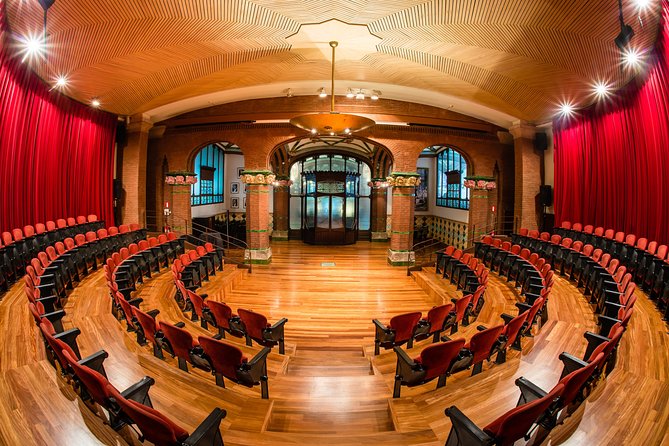
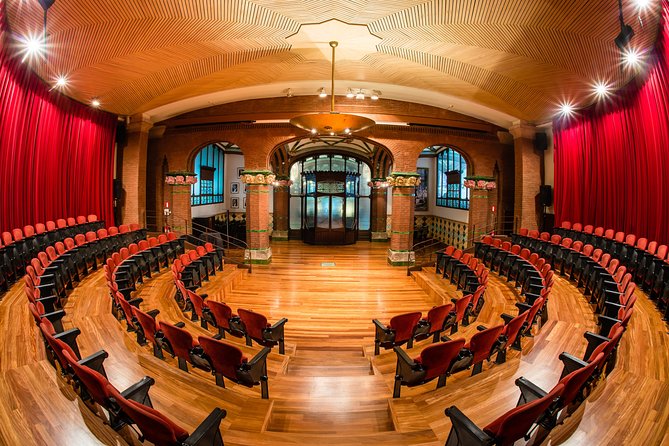
The tour begins in the rehearsal hall of the Orfeó Català. This is where the foundation stone was laid in 1905, giving the room a direct link to the building’s beginnings rather than serving as a random first stop.
You watch a 15-minute audiovisual presentation about the Palau’s construction, its early years, and the social setting of early 20th-century Barcelona. This is a smart use of the first part of the tour. It gives you the basic timeline before the guide starts pointing out artistic details.
The film may feel less exciting than walking straight into the main hall, especially if your schedule is tight. Still, I would not treat it as filler. The Palau can be visually overwhelming, and a little background helps you understand why the building was created for a choral society and why its decoration leans so heavily on music and nature.
This opening also gives the guide a chance to establish the story before the group moves through the more ornate rooms. If you arrive knowing nothing about the building, you should leave this section with enough context to follow the rest of the tour.
The tiled staircases and glass balusters
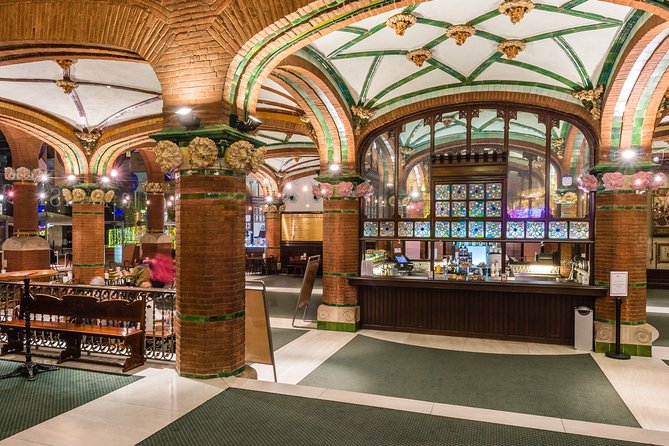
From the rehearsal room, you move toward the elaborate staircases leading to the second floor. This is one of the places where a short guided visit earns its keep. Most people naturally look ahead as they climb, but the design asks you to look down and sideways too.
The undersides of the stairs are covered with carefully arranged tiles. The marble banisters are supported by unusual glass balusters, adding another layer of light and color to what might otherwise be a purely functional passage.
Take your time here if the group allows it. The staircase is not just a route to the next room. It shows how the Palau carries its decorative language into ordinary architectural elements. Walls, ceilings, railings, and columns all contribute to the effect.
Photography can be tricky in this part of the tour because the group keeps moving and the surfaces catch the light. I suggest taking a few quick pictures, then looking with your own eyes. The tiled patterns are easier to understand in person than on a hurried phone screen.
Same city, a completely different evening:
- Barcelona: Park Güell Admission Ticket
★ 4.4 · 76,534 reviews - Barcelona: Casa Batlló Entry with Self-Audioguide Tour
★ 4.7 · 25,359 reviews - Barcelona: 24 or 48-Hour Hop-On Hop-Off Bus Tour
★ 4.4 · 20,872 reviews - Barcelona in 1 Day: Sagrada Familia, Park Guell,Old Town & Pickup
★ 5.0 · 13,541 reviews
Lluís Millet Hall and the balcony colonnade
At the top of the stairs, you enter the Lluís Millet Hall. Floor-to-ceiling windows look onto the balcony colonnade of the main façade, giving you a close view of the columns and their floral mosaics.
This room offers a useful pause after the darker, more enclosed staircase. Natural light changes the mood, and the windows frame the exterior decoration as if it were another exhibit. The flower motifs reflect the building’s wider use of nature as a symbol of growth and life.
The hall is named for Lluís Millet, one of the founders of the Orfeó Català. The guide connects the room to the people and institutions behind the Palau, helping you see that this was not merely an architect’s private project. It was built around a musical and cultural organization.
This is also a good place to ask a question if your guide allows time. Some tours move briskly, and one less favorable experience involved a guide speaking mechanically and quickly. You may be given an earpiece, which helps in a small group, but check the volume early so you do not miss the explanation.
The Concert Hall and its inverted glass dome
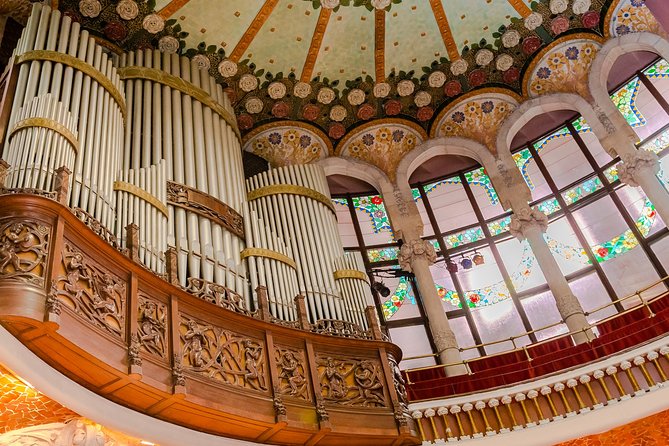
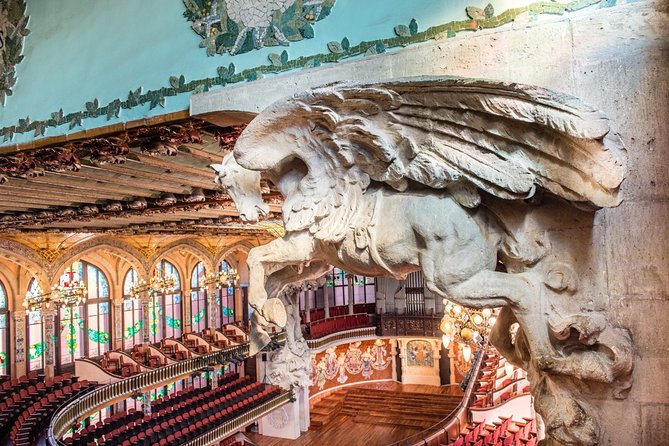
Then comes the room you have been waiting for: the Concert Hall. The first impression is powerful because the decoration surrounds you on every side. Stained-glass panels sit in arches along the walls, sculptures frame the stage, and the ceiling’s central skylight forms a large inverted dome.
The skylight is the hall’s visual centerpiece. It pulls daylight down into the room and gives the ceiling the appearance of opening toward the sky. When you stand beneath it, the hall feels lighter and more open than its ornate surfaces might suggest.
Look toward the stage as well as upward. The sculptures and decorative forms are not random flourishes. Your guide explains the work of artists such as Eusebi Arnau and Pau Gargallo, while also discussing the ceramics, mosaics, and stained glass associated with Lluís Bru and Antoni Rigalt.
The hall is still an active performance space. You might see musicians rehearsing, and some visits have included an organist and vocalist preparing for a performance. That possibility adds something special, although it is not guaranteed and should not be the reason you book the tour.
The organ is another detail worth noticing. It has almost 3,000 pipes, and on some visits the guide has played it for the group. Again, this depends on the day and the schedule, but hearing the organ gives you a direct sense of the building as a working music hall rather than a preserved monument.
Sound, stage design, and the building’s real purpose
The Palau’s beauty can distract you from its practical purpose. This is a concert hall, and its design was shaped by sound as much as sight. The guide discusses how the hall works for singers and orchestras, which helps explain why visitors often pay close attention to the acoustics.
You may not get a full acoustic demonstration during the tour, but the explanation gives meaning to the architecture. The stained glass and mosaics are memorable, yet the building would not succeed as a concert venue if it only looked good.
The best visits balance art and engineering. You learn why the architects made certain choices, then stand in the hall and test those ideas with your own senses. If the organ is played or a rehearsal is underway, the experience becomes even more direct.
One point to keep in mind: this is not a full concert or behind-the-scenes production tour. You are seeing selected public spaces, not every working area of the venue. The experience is designed to introduce the building’s architecture and history in a short format.
What the one-hour schedule feels like
The official length is about one hour, including the film and the guided walk. That makes this a handy choice for a morning or afternoon gap. You finish back near the exit and can continue into the surrounding old city without a complicated transfer.
The short length is both an advantage and a limitation. I like that the tour does not swallow a large section of your Barcelona day. On the other hand, the Palau contains enough detail to occupy much longer, and a fast guide may leave you wishing for more time.
The group size helps keep the pace manageable. With no more than 15 people, you should be able to hear the guide and move through the rooms without the scale of a large tour group. Still, the visit is structured. You cannot linger indefinitely in the Lluís Millet Hall or Concert Hall if the group is moving on.
If you are an architecture fan, arrive ready to focus. The tour covers many names, symbols, materials, and construction details in a short period. If you prefer a slow, unstructured museum visit, you may find the format brisk.
Is $26.60 good value?
At $26.60 per person, this is not the cheapest quick attraction in Barcelona, but the price includes the admission ticket, local guide, and 15-minute audiovisual presentation. You are paying for access to a UNESCO-listed concert hall plus an explanation of what you are seeing.
I consider that fair value if you care about architecture, music, or Barcelona’s modernist movement. The building’s details are easy to admire on your own, but the guide adds meaning to the sculptures, tilework, artists, and acoustic design.
The value is weaker if you are already overloaded with ornate churches, palaces, and Gaudí sites. The Palau is beautiful, but it is not a must for every short Barcelona visit. If you have only one day in the city, put your time toward the sights that matter most to you.
Prebooking is sensible because popular time slots can fill. The average booking lead time is about 29 days, which suggests that many people plan this visit ahead rather than deciding at the door. Free cancellation is available up to 24 hours before the start time, but changes or cancellations within 24 hours are not refunded.
Who should take this tour?
I would recommend it to anyone who wants to understand Barcelona beyond its most famous Gaudí buildings. It suits couples, families, solo visitors, and anyone with a free hour in Ciutat Vella.
It is especially good for:
- People who enjoy stained glass, mosaics, sculpture, and decorative architecture
- Music lovers who want to see an active concert hall
- Visitors who prefer a guide to explain symbols and construction choices
- Anyone fitting a cultural stop into a packed itinerary
- First-time visitors who want a clear introduction to Catalan modernism
It may be less suitable if you dislike guided pacing or want extensive time for photography. The tour is also not a concert ticket. If you want a full musical evening, you would need to book a performance separately.
The activity allows service animals, is near public transportation, and is suitable for most people. Specific mobility details are not provided, so contact the provider if you need information beyond that.
Practical tips for a better visit
Choose a time slot that leaves you unhurried. Arriving early is wise because the meeting point may be interpreted differently, and you do not want to search for the guide at the last moment.
Check your earpiece as soon as the tour begins. Several guides use listening devices, and you can control the volume. That is helpful, especially if your guide speaks quickly or the group is spread across a staircase or large hall.
During the film, listen for the basic story of the building. Once inside the concert hall, focus on the details the film could not show you: the floral mosaics, sculpted stage decoration, glasswork, and the inverted dome.
Keep some time after the tour if you want to admire the building at the exit or stop for a drink. Food and beverages are not included, although the venue has places where you can eat or have a drink.
Should you book the Palau de la Música tour?
Book it if you want a compact, well-organized look at one of Barcelona’s most extraordinary interiors. The Concert Hall alone is a strong reason to go, and the guide, film, and small group make the $26.60 price easier to justify.
I would be more cautious only if your schedule is extremely tight or if you prefer to spend every cultural hour at Barcelona’s biggest headline sights. For most visitors with an available hour, this is a smart addition. The building is beautiful enough to surprise people who had not planned to see it, and the tour gives you the context to notice far more than the colors and glass.
FAQ
How long does the Palau de la Música Catalana Guided Tour last?
The tour lasts approximately one hour, including the 15-minute audiovisual clip and the guided visit through the building.
What is included in the tour price?
The price includes a local guide, the 15-minute audiovisual clip, and admission to the Palau de la Música Catalana.
Is the tour offered in English?
Yes. The experience is offered in English.
Where does the tour begin and end?
You meet at the Palau de la Música Catalana at C/ Palau de la Música, 4-6, in Barcelona’s Ciutat Vella. The activity ends back at the meeting point, near the exit.
How large is the tour group?
The tour has a maximum of 15 participants.
Does the tour include food or drinks?
No. Food and drinks are not included.
Can I cancel for a full refund?
Yes, if you cancel at least 24 hours before the experience start time. Cancellations or changes made less than 24 hours in advance are not refunded.
Recently added in Barcelona
- Barcelona: Catamaran Cruise w/ Sailing, Wine, & Tapa★ 4.7 · 176 reviews
- Guided Gaudí Trencadís Mosaic Workshop in Barcelona 2 Hours★ 5.0 · 176 reviews
- Barcelona Cable Car Sky Views, Magic Fountain & Castle Visit★ 4.2 · 177 reviews
- Barcelona Private Sunset Sailing with Drinks★ 5.0 · 177 reviews
- Barcelona: Montserrat with Winery Visit and Farmhouse Lunch★ 4.7 · 178 reviews
- Barcelona: Nightmare Horror Museum Maze Entry Ticket★ 4.5 · 179 reviews
- Barcelona: City Sights Electric Quad Tour★ 4.8 · 178 reviews
- Barcelona: Professional Photoshoot Outside Sagrada Familia★ 4.8 · 179 reviews
Guided, compared.
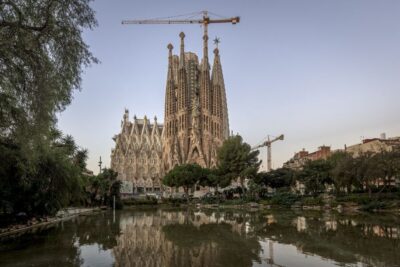
Sagrada Familia Entry Ticket with Audio Guide
Read the review →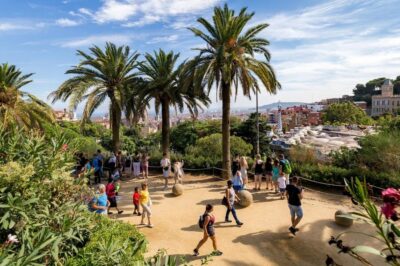
Park Guell Guided Tour with Skip The Line Entry
Read the review →La Pedrera-Casa Milà Ticket & Audio Guide Option
Read the review →
Caminito del Rey Guided Tour with Transportation
Read the review →
Caminito del Rey: Guided Tour and Entry Ticket
Read the review →
Skip-the-Ticket-Line Mosque-Cathedral Guided Tour
Read the review →