
Reviewed · WALKING TOURS
Barcelona 2-Hour Gothic Walking Tour
Barcelona’s Gothic Quarter is best understood on foot, and this tour gives you the clues you need to read its tangled lanes. In two hours, you move from Roman Barcelona to medieval royal power, with stops at the Cathedral cloister, Saló del Tinell, the Chapel of Santa Àgata, and Plaça Sant Felip Neri.
I like the way the tour connects grand monuments with small details you could easily walk past alone. I also like the English tour’s free time at the Museu Frederic Marès, a fitting extra stop in a medieval palace. The main consideration is simple: two hours on cobblestones can feel tiring, especially in hot weather, so eat and drink before you start.
Key points at a glance
- Roman ruins in a medieval quarter: See the Temple of Augustus and learn how Barcino shaped today’s Barcelona.
- The Cathedral from a closer angle: Explore the Gothic Cathedral and its cloister, rather than simply photographing the façade.
- Royal history at Plaça del Rei: Visit the Palau Reial Major, Chapel of Santa Àgata, and Saló del Tinell.
- A moving stop at Plaça Sant Felip Neri: See church walls marked by damage from Spanish Civil War bombings.
- Extra museum time for English participants: Enter the Museu Frederic Marès after the walk and explore at your own pace.
- Strong guide-led experience: Guides such as Olga Escribano, Jordi, Alex, Pilar, and Alexandra are praised for clear explanations, humor, and helpful city advice.
Why a guided walk works so well here
The Gothic Quarter can look like a maze of old stone, narrow passages, and attractive squares. Without context, you may admire the architecture but miss the layers beneath it. A guide gives those layers a clear order.
This part of Barcelona contains traces of the Roman settlement of Barcino, medieval churches and royal buildings, later political upheaval, and the everyday life of modern Catalonia. The tour is not just a march from one monument to another. It explains how buildings, streets, religion, monarchy, and local identity fit together.
I especially value the scale. You are not crossing the city or losing time on transport. The main sights sit close together, so the two-hour route can cover a surprising amount without feeling like a forced citywide overview. One visitor with movement difficulty found the pace comfortable, while another rightly pointed out that you should still be ready to walk for the full two hours.
The meeting point is at the tourist information office near Plaça de la Seu. Look for the information symbol. The route returns to the same Plaça de la Seu area, which makes it convenient to continue toward other central sights afterward.
More Walking Tours in Barcelona
- Barcelona Tapas and Wine Experience Small-Group Walking Tour
★ 5.0 · 5,804 reviews - Barcelona: Tapas Walking Tour with Food, Wine, and History
★ 4.8 · 4,261 reviews - Barcelona Tapas Walking Tour: Food, Wine & History
★ 4.5 · 1,928 reviews
Starting at Plaça de la Seu and the Cathedral
Plaça de la Seu is a sensible place to begin. It puts you beside Barcelona Cathedral, one of the quarter’s main landmarks, and gives the guide an immediate setting for explaining the old city.
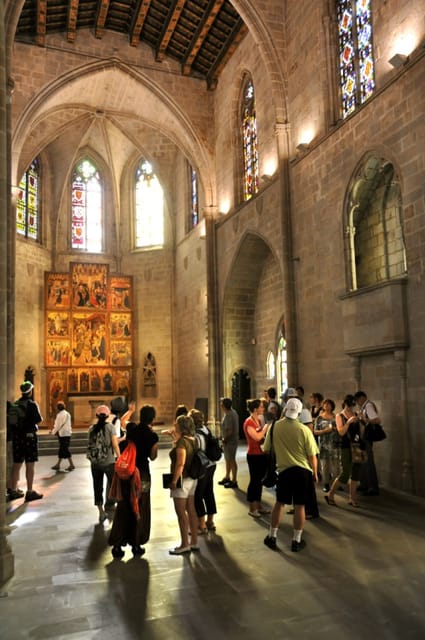
The Cathedral is more than a quick photo stop. The guided visit takes you closer to its Gothic design and includes the cloister, a quieter and more enclosed space than the square outside. This is where the building’s details can make more sense. Instead of seeing only height and decoration, you get a better feel for how religious buildings shaped medieval Barcelona.
The cloister is also a useful contrast to the streets outside. The Gothic Quarter can be noisy and crowded, but this part of the Cathedral offers a pause. Your guide can point out features that are easy to miss when you are moving through the area alone.
The itinerary also includes the Chapel of Santa Àgata. Its connection with the former royal complex adds another layer to the walk. You are not looking at isolated monuments. The Cathedral, chapel, palace, and public squares belong to the same old center of power.
One practical point: the experience is described as a guided visit to the Cathedral, but the exact amount of indoor access can depend on operating conditions. The cloister is specifically included in the description, so that is the part to keep in mind when deciding what you want from the tour.
Finding the Roman Temple of Augustus
One of the most rewarding parts of the walk is the Roman Temple of Augustus. It is easy to miss because it is tucked into the medieval street pattern rather than presented in a broad, open archaeological park.
The temple is a reminder that Barcelona’s story did not begin in the Middle Ages. The Roman settlement of Barcino formed the foundation for the city, and the surviving columns give you a physical link to that earlier period.
This is exactly the kind of stop where a guide earns the fee. You might pass through the surrounding lanes and never realize what is nearby. With an explanation, the columns become more than old stones. They show how Roman Barcelona was folded into the later city, with medieval buildings growing around much older remains.
The tour also touches on the Museu d’Història de Barcelona area. The exact itinerary describes a guided stop connected with the city’s history, so expect more discussion of Barcelona’s ancient and medieval layers rather than a long, separate museum visit during the two-hour walk.
Plaça del Rei and the royal quarter
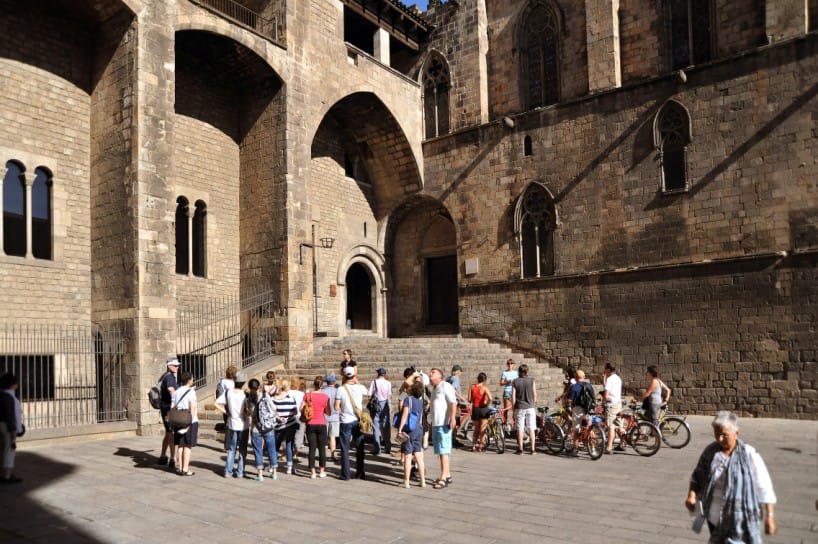
Plaça del Rei is one of the strongest stops on the route. The square has the enclosed, stone-built character people often hope to find in the Gothic Quarter, and it brings together several important buildings.
Here you see the Palau Reial Major, once home to Catalan kings, along with the Chapel of Santa Àgata and the Saló del Tinell. The Saló del Tinell is particularly important for understanding the political weight of the site. It was a grand ceremonial hall, and the tour connects it with the meeting of Ferdinand and Isabella with Columbus after his voyage to the New World.
That story gives the square a human angle. You are not simply studying Gothic arches. You are standing in a place tied to monarchy, court ceremony, and the expanding ambitions of late medieval Spain.
I like this section because it helps you separate Barcelona’s different kinds of power. The Cathedral represents religious authority. The royal buildings show political authority. The lanes around them reveal the working city that grew between and around these institutions.
The buildings may be closed or viewed from the exterior depending on the schedule and access arrangements, so you should think of the guide’s interpretation as the main value here. This is not a full palace tour with hours inside every room. It is a compact walk through the royal center, with the guide supplying the essential context.
A few other Barcelona outings to compare
- Barcelona: Two-Hour Midday or Sunset Sailing Cruise
★ 4.8 · 1,732 reviews - Barcelona: 2-Hour City Sights Guided Segway Tour
★ 4.9 · 453 reviews - Barcelona: 2-Hour Sailboat Tour with Snacks and Drinks
★ 4.8 · 357 reviews - Barcelona: Jewish Quarter 2-Hour Walking Tour
★ 4.8 · 333 reviews
Carrer del Bisbe and the quarter’s narrow lanes
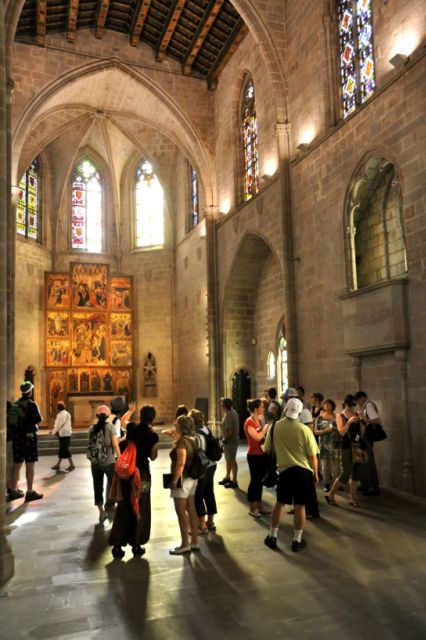
The walk through the Gothic areas is not only about fixed monuments. Some of the pleasure comes from moving through the streets themselves.
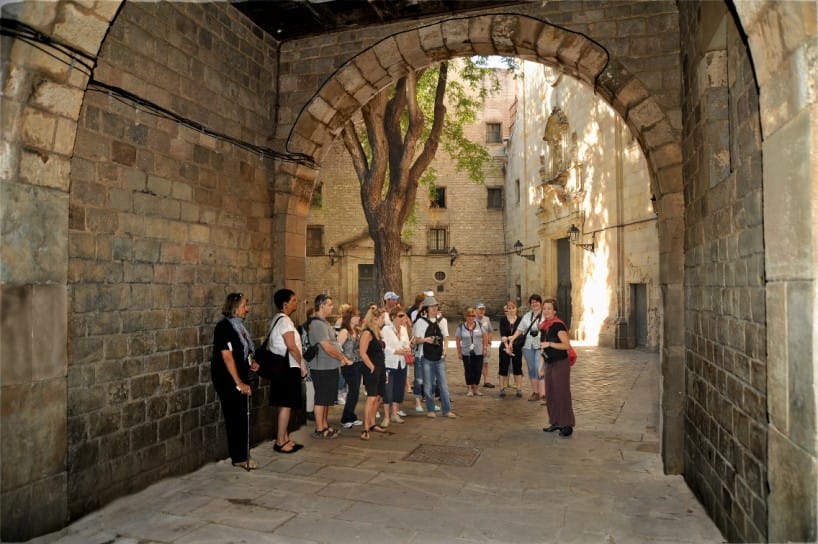
Carrer del Bisbe is a highlight for photographs, with its Gothic façade details and flower-filled balconies. It is also a good example of how the quarter creates its mood through close views. Look up as you walk. Doorways, bridges, carved stone, and upper-floor details can disappear if you focus only on the pavement.
The guide’s role here is to make the street legible. You may hear stories of medieval merchants, knights, saints, love, betrayal, and revolution. These tales give shape to a place that could otherwise feel like a collection of pretty lanes.
Do not expect every alley to be silent or empty. This is a working part of central Barcelona, with shops, restaurants, and plenty of foot traffic. That mix is part of the point. The quarter is not a preserved stage set. Its old buildings sit beside modern city life.
For photographers, the route offers many opportunities, but it is worth listening before stopping for pictures. Some lanes are tight, and pausing in the middle can block the group or other people passing through.
Plaça Sant Felip Neri and a harder chapter
Plaça Sant Felip Neri is perhaps the most emotionally powerful stop. The square is quiet compared with the main routes, and its baroque church gives the place a graceful appearance. Then you notice the pockmarked walls.
The marks come from Spanish Civil War bombings. The square therefore carries a painful history beneath its calm surface. Children may play there, and musicians may sometimes perform, but the damaged walls remain a direct reminder of violence.
This is a good example of the tour’s wider approach. It does not present Barcelona only as a city of handsome Gothic buildings and pleasant tapas bars. It also acknowledges the events that left scars on the city.
Give yourself a moment here. The guide will provide the historical explanation, but the square works best when you also take in the atmosphere without rushing to the next stop. It is a place where architecture and memory meet.
The Museu Frederic Marès bonus
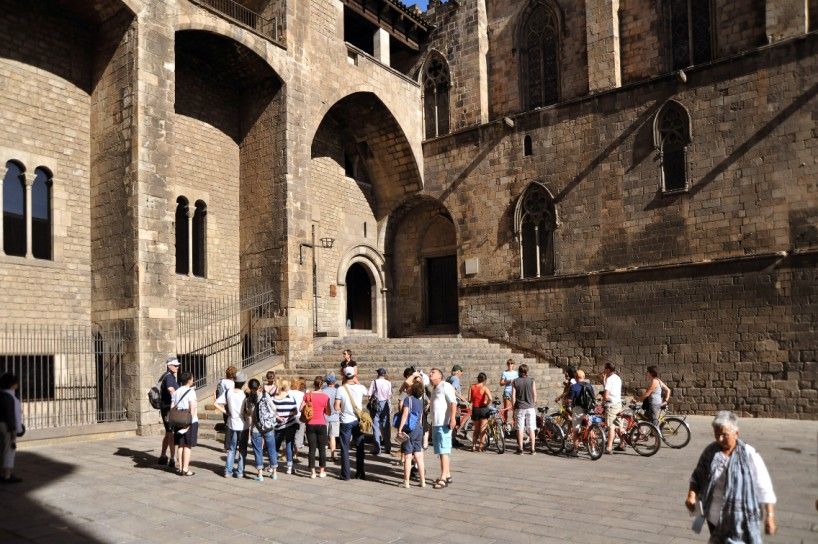
The English-language tour includes free admission to the Museu Frederic Marès after the walking portion. This is a real advantage, but you should understand how it works: the museum visit comes after the two-hour guided walk, with free time for you to explore rather than an additional full guided tour.
The museum occupies a medieval palace and contains Frederic Marès’s collection of sculpture, religious art, antique curiosities, and everyday objects from the 19th century. That range makes it different from a standard art museum. You can move from medieval devotional pieces to ordinary personal items and household objects.
I like this as a finale because the walking tour first gives you the city’s buildings and public spaces, then the museum adds smaller objects and private details. After seeing royal halls, chapels, and old streets, you get a closer look at the kinds of art and belongings that shaped domestic and religious life.
The extra admission improves the value of the $32 price, especially if you have time to stay after the tour. If your schedule is tight, however, the museum benefit matters less. You should not book the tour solely for the museum if you need to leave immediately after the walk.
Guides, pace, and group experience
The clearest strength of this experience is the guiding. Names praised in the supplied information include Olga Escribano, Jordi, Alex, Pilar, Alexandra, Luca, Miguel, Theo, and Val. The descriptions of these guides repeatedly emphasize strong historical preparation, humor, patience, and an ability to answer questions.
That matters in the Gothic Quarter because the material can become dry if it is delivered as a list of dates and buildings. The best guides make the past easier to picture. Olga Escribano, in particular, is repeatedly described as enthusiastic, flexible, and generous with personal attention. Jordi is praised for his clear command of Barcelona’s past, while Alex is noted for answering questions and offering further city advice.
Guide quality can vary from one departure to another, and you cannot assume you will receive a particular person. Still, the repeated pattern suggests that the tour depends on a well-prepared local guide rather than a recorded script.
The pace appears steady and manageable. The route stays within one compact area, so you do not walk great distances between sights. Even so, you should wear sensible shoes. Cobblestones, standing, and frequent stops can be tiring, and one useful tip from the experience is to eat before you arrive and carry water. A hungry walker is rarely a patient listener.
Some departures may use audio equipment to help you hear the guide. This proved useful in rainy conditions, when umbrellas made it harder to stay close and listen. The tour can operate in wet weather, but the experience is plainly better with comfortable shoes and suitable clothing.
Is $32 a fair price?
At $32 per person, this is a reasonable price for a two-hour guided walk in one of Barcelona’s most historically important areas. You are paying for a local guide, structured access to the quarter’s major stories, and the extra museum admission included with the English tour.
The value is strongest if you are new to Barcelona or have limited time. A self-guided walk costs less, but you would need to research the Roman Temple of Augustus, royal buildings, Cathedral details, and Civil War history yourself. You might also miss several sites simply because they are not obvious from the street.
The value is also good for first-day planning. A number of guides offer suggestions for other sights and local food after the walk. Since the route ends near Plaça de la Seu, you can use the remaining day to follow up on places that caught your interest.
I would be less enthusiastic if you have already taken a detailed Gothic Quarter tour or spent several days studying Barcelona’s medieval center. In that case, the route may repeat material you know. The Museu Frederic Marès can still make it worthwhile, but only if you have enough time to visit it afterward.
Who should book this Gothic Quarter walk?
I would recommend it to first-time visitors who want a clear introduction without committing to a half-day tour. It suits history fans, architecture lovers, photographers, and families with older children or teenagers who enjoy stories more than a long museum lecture.
It is also a good choice for anyone who feels unsure about exploring narrow old-city streets alone. The guide gives you a route, points out places you would likely miss, and explains how the quarter developed.
The tour may be less suitable for anyone who cannot comfortably stand or walk for two hours. One participant with movement difficulty found the pace acceptable, but the general advice remains important: this is a walking tour, not a seated sightseeing experience.
The English language option is the one connected with free time at the Museu Frederic Marès. If that museum matters to you, confirm that you are selecting the English departure.
Booking is flexible, with free cancellation up to 24 hours before the start and a reserve-now, pay-later option. Starting times vary, so check the available departure before planning a Cathedral visit or restaurant reservation around it.
Should you book it?
Book this tour if you want the Gothic Quarter to make sense rather than simply look attractive. The strongest reasons are the Roman remains, the Cathedral cloister, the royal complex at Plaça del Rei, and the thoughtful stop at Plaça Sant Felip Neri.
The two-hour length keeps the commitment manageable, and the $32 cost is helped by the included Museu Frederic Marès visit. Just arrive fed, bring water, and wear shoes suited to old stone streets.
If you prefer exploring at your own pace or already know Barcelona’s medieval center well, you may find the guided structure unnecessary. For most first visits, though, this is a practical way to get your bearings and see why the Gothic Quarter is more than a maze of handsome buildings.
FAQ
How long is the Barcelona Gothic Walking Tour?
The guided walking tour lasts two hours.
What language is the tour offered in?
The live guided tour is offered in English.
Where does the tour meet?
The meeting point is at the tourist information office near Plaça de la Seu. Look for the information symbol.
Where does the tour finish?
The listed drop-off location is Plaça de la Seu, the same central area used for the meeting point.
Is Barcelona Cathedral included?
Yes. The itinerary includes a guided visit to Barcelona Cathedral, including a closer look at the cloister.
Does the tour visit the Chapel of Santa Àgata?
Yes. The Chapel of Santa Àgata is included as a guided stop.
Is the Museu Frederic Marès included?
English-language participants receive free admission and free time at the Museu Frederic Marès after the walking tour.
Can I cancel the booking?
You can cancel up to 24 hours in advance for a full refund. The activity also offers a reserve-now, pay-later option.
Recently added in Barcelona
- Barcelona: Catamaran Cruise w/ Sailing, Wine, & Tapa★ 4.7 · 176 reviews
- Guided Gaudí Trencadís Mosaic Workshop in Barcelona 2 Hours★ 5.0 · 176 reviews
- Barcelona Cable Car Sky Views, Magic Fountain & Castle Visit★ 4.2 · 177 reviews
- Barcelona Private Sunset Sailing with Drinks★ 5.0 · 177 reviews
- Barcelona: Montserrat with Winery Visit and Farmhouse Lunch★ 4.7 · 178 reviews
- Barcelona: Nightmare Horror Museum Maze Entry Ticket★ 4.5 · 179 reviews
- Barcelona: City Sights Electric Quad Tour★ 4.8 · 178 reviews
- Barcelona: Professional Photoshoot Outside Sagrada Familia★ 4.8 · 179 reviews
Walking Tours, compared.

Barcelona Tapas and Wine Experience Small-Group Walking Tour
Read the review →
Tapas Walking Tour with Food, Wine, and History
Read the review →
Albaicín and Sacromonte Guided Sunset Walking Tour
Read the review →
Toledo Tour & Vineyard Walk with Wine Tasting from Madrid
Read the review →

Barcelona Tapas Walking Tour: Food, Wine & History
Read the review →
Madrid Old Town & Royal Palace Walking Tour Skip the Line Ticket
Read the review →
Browse the lists this tour appears in