
Reviewed · WALKING TOURS
Barcelona: Jewish Quarter 2-Hour Walking Tour
Barcelona’s Jewish Quarter is easy to miss. The streets are narrow, the clues are often small, and much of the medieval community disappeared centuries ago. This two-hour walk helps you read the Gothic Quarter through Jewish history, from the Sinagoga Mayor to the site of a medieval Mikve and the ruins of the Old Synagogue.
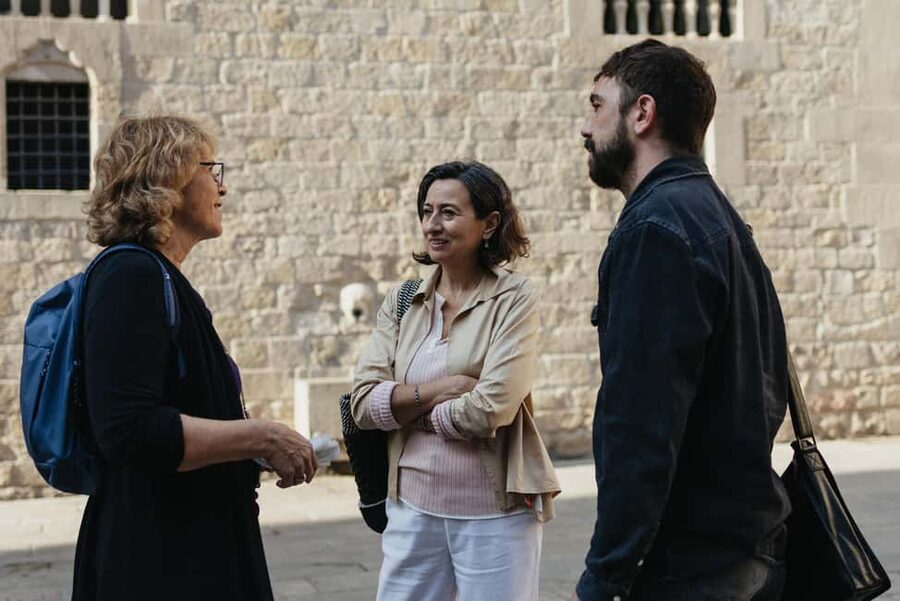
I like the small groups of up to six, which give your guide room to answer questions and adjust the pace. I also like the focus on places you could easily pass without noticing, including the former home of a Jewish alchemist and the locations of four synagogues. The main drawback is that the Synagogue Museum entrance costs extra, and the Old Synagogue may occasionally be closed.
Key points to know before you book
- Sinagoga Mayor: Visit Spain’s oldest synagogue, also presented as one of Europe’s oldest surviving synagogues.
- Four synagogue sites: Walk through central Barcelona to locate four places connected with Jewish worship.
- Medieval Mikve: See the unusual remains of a ritual bath from the Middle Ages.
- Small-group setting: Groups are limited to six, so guides such as Edu, Ella, and Lilach can keep the walk conversational.
- Two-hour Gothic Quarter route: Start and finish at Plaça Sant Jaume, with no hotel transport included unless you pay an additional €30.
- Useful flexibility: You can cancel up to 24 hours before the tour for a full refund and reserve now while paying later.
Reading Barcelona through its Jewish past
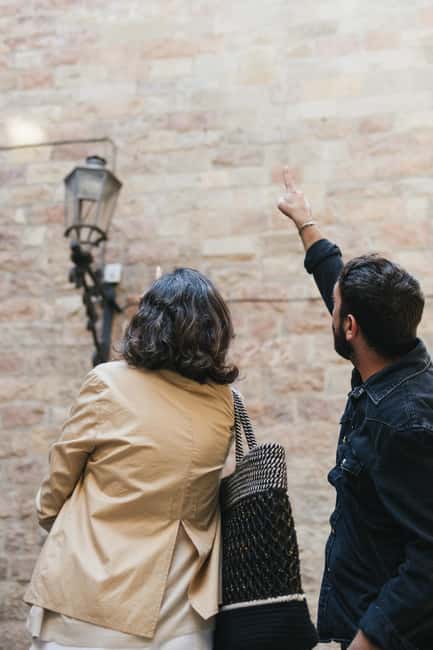
This tour is not simply a walk past attractive old buildings. It asks you to look for traces of a community that helped shape Barcelona and then vanished from the city after the violence of 1391.
Your guide explains that Jewish communities began arriving in Spain as early as the third century, after the destruction of the Second Temple in Jerusalem in 70 CE. In Barcelona, the community grew over the centuries and held an important place in the city’s political, commercial, and spiritual life.
That long timeline gives the walk its weight. You are not hearing a short story about a single building. You are following the rise of a community, its daily life in the medieval city, and the sudden end of its presence in Spain.
The story is also told in the streets themselves. The Gothic Quarter’s lanes follow an old urban pattern, with Roman walls and medieval buildings pressed close together. Your guide points out how the Jewish Quarter fitted into this compact center and helps you connect surviving structures with places that have changed or disappeared.
I find this kind of tour especially useful early in a Barcelona visit. The Gothic Quarter can feel like a maze of churches, stone alleys, and small squares. After the walk, you will have a clearer sense of how to notice less obvious details rather than simply passing through on the way to the cathedral.
More Walking Tours in Barcelona
- Barcelona Tapas and Wine Experience Small-Group Walking Tour
★ 5.0 · 5,804 reviews - Barcelona: Tapas Walking Tour with Food, Wine, and History
★ 4.8 · 4,261 reviews - Barcelona Tapas Walking Tour: Food, Wine & History
★ 4.5 · 1,928 reviews
Plaça Sant Jaume and the walk into the Gothic Quarter
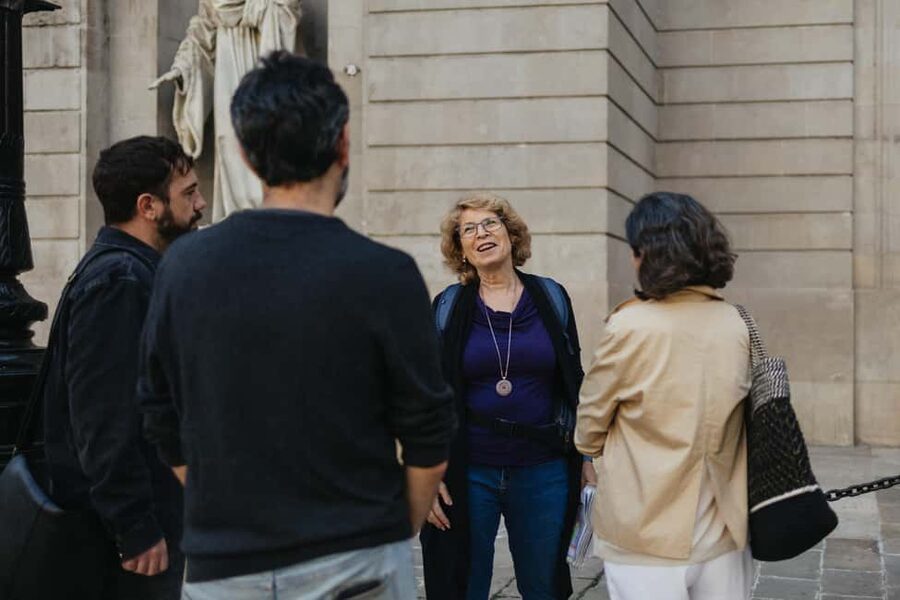
The meeting point is Plaça Sant Jaume, beside the Alcampo store. This is a practical central location, but the square itself also sets the tone for the tour. You are beginning in the heart of Barcelona’s old center, where layers of civic and religious history sit close together.
The route then leads into the Gothic Quarter. Expect a walking tour through narrow lanes dating from the Middle Ages, with stops at places tied to Jewish life. The guide does the work of joining the pieces together, since many of the buildings no longer look Jewish at first glance.
The group size matters here. With no more than six people, you should be able to hear clearly in tight streets and ask questions without holding up a large crowd. Several guides, including Edu, Ella, Lilach, and Alan, have been praised for explaining difficult history in a clear, friendly way.
The pace also appears to be adaptable. Edu has been especially good at adjusting his speed, speaking clearly, and allowing time for rest. That makes the tour a reasonable option for older people or anyone with walking concerns, although you should still expect two hours on foot through an old quarter.
Sinagoga Mayor, the tour’s central stop
The visit to Sinagoga Mayor Barcelona is the clearest highlight. It is described as Spain’s oldest synagogue and one of the oldest synagogue buildings in Europe. The site gives you a physical place to connect with the broader history your guide has introduced.
Do not expect a large modern synagogue complex. The value here is in the age, setting, and survival of the building within the medieval quarter. Its presence helps explain how close the Jewish community lived and worshipped to the city’s Roman and medieval center.
The Synagogue Museum entrance is not included in the tour price. That is an important cost detail. The walking tour itself is listed at $76 per person, while entry to the museum requires a separate fee. If you want the fullest visit, allow room in your budget for that extra admission.
The tour includes skip-the-line access, which can save time if there is a queue. Still, the exact visit conditions can change. One person found the Old Synagogue closed, so it is wise to treat access to individual interiors as subject to local opening conditions rather than a guarantee of every room advertised.
Four synagogue locations hidden in plain sight
The walk identifies four synagogues in Barcelona’s city center. This does not mean that all four are necessarily functioning places of worship open for full interior visits. The important point is that your guide shows you where they were and explains how they fit into the old Jewish Quarter.
I like this part because it turns the city into a historical map. You begin to see that Jewish Barcelona was not one isolated building. It was a network of homes, religious sites, businesses, and streets connected to the wider medieval city.
The remains can be subtle. A doorway, wall, foundation, or change in the shape of a building may carry more meaning after your guide explains it. That is where a personal guide adds real value. Without context, you might walk past these places and see only another old stone lane.
Alan has used maps, photographs, and reconstructions to explain how earlier settlements and buildings looked. That sort of visual help can be useful, especially when modern Barcelona has covered or altered the medieval layout.
A few other Barcelona outings to compare
- Barcelona: Two-Hour Midday or Sunset Sailing Cruise
★ 4.8 · 1,732 reviews - Barcelona: 2-Hour City Sights Guided Segway Tour
★ 4.9 · 453 reviews - Barcelona: 2-Hour Sailboat Tour with Snacks and Drinks
★ 4.8 · 357 reviews - 2-Hour Sailing Tour in Barcelona with Open Bar & Snacks
★ 5.0 · 318 reviews
The medieval Mikve and the Jewish alchemist’s house
The medieval Mikve is another distinctive stop. A Mikve is a ritual bath, and the remains offer a rare look at an aspect of Jewish religious life that is easy to overlook in a general city tour.
The stop is valuable because it moves the story beyond famous monuments. You are not only learning about public worship or political events. You are also seeing how religious practice shaped the physical layout of the community.
The route also includes the ruins of a house owned by a Jewish alchemist. The remains provide an opportunity to consider the work and skills of individuals within medieval Barcelona. Your guide brings the setting to life through the art, architecture, and surviving fragments of the building.
This is one reason I would not judge the tour only by the number of intact sights. The Jewish Quarter has been altered by centuries of rebuilding, so the experience depends on interpretation. If you want a polished sequence of complete monuments, this may feel restrained. If you enjoy piecing together a vanished neighborhood, it is far more rewarding.
The Old Synagogue and the end of medieval Jewish Barcelona
The tour also visits the ruins of the Old Synagogue, associated with Shlomo Ben Adret. This stop links the physical remains to the intellectual and religious life of medieval Barcelona.
Your guide explains how the community lived in relative peace for centuries before the attacks of 1391 brought a brutal end to Jewish life in the city and helped close the chapter on Jewish presence in Spain. The subject is painful, but it is central to understanding why so few visible structures remain.
The Old Synagogue may be closed at times. That possibility is worth keeping in mind when you book. Even if the interior cannot be entered, the surrounding Jewish Quarter and the guide’s explanation still form an important part of the walk, but the experience will be less complete than a fully open visit.
The tour finishes back at Plaça Sant Jaume. That return is convenient if you want to continue exploring the Gothic Quarter, visit another nearby sight, or stop for a meal without arranging transport from a distant drop-off point.
How the guides shape the experience
The guide makes a large difference on a subject with many dates, changing borders, and difficult terminology. The most praised guides have included Edu, Ella, Lilach, and Alan.
Edu has been noted for combining information with natural conversation. He has adjusted walking speed, answered questions, confirmed meeting details in advance, and made space for both adults and teenagers. That matters if your group includes different ages or interests.
Ella has been praised for her clear explanations of Catalan, Barcelona, and Jewish medieval history. Lilach has brought an engaging approach to the history of Jews in Spain and has been especially good at answering questions. Alan has used maps and visual material while also paying attention to the group’s safety in rainy weather.
You cannot select a particular guide from the information provided, so do not book on the assumption that one named person will lead your departure. The useful point is that several guides have received strong praise for preparation, warmth, clarity, and flexibility.
The tour is offered in English. If you want a lecture with little conversation, a larger group might suit you just as well. If you prefer to ask about family history, architecture, religious practice, or Barcelona today, the six-person limit is a strong advantage.
What the $76 price buys you
At $76 per person, this is not a cheap orientation walk. The price makes the most sense if Jewish history is a major reason for your visit, or if you value a small group and a specialist guide rather than a broad city overview.
The fee includes the walking tour, but not hotel pick-up or the Synagogue Museum entrance. Hotel pick-up costs an additional €30, and the meeting point at Plaça Sant Jaume is central enough that many people may prefer to meet the guide there.
You are paying mainly for interpretation. The buildings and lanes are part of Barcelona’s public city center, but the connection between them is not obvious. A guide who can explain the locations of four synagogues, identify the Mikve, place the alchemist’s house in context, and explain the events of 1391 gives the walk its value.
I would compare this price with your own priorities. A general Gothic Quarter tour may cover more famous monuments for less money. This walk covers a narrower subject with greater depth. For someone tracing family history, studying Jewish Spain, or wanting to understand a part of Barcelona often missed by standard sightseeing, the extra cost can be justified.
Timing, walking comfort, and group size
The tour lasts two hours, with starting times shown when you check availability. That makes it easy to fit around a morning visit, an afternoon museum stop, or dinner plans.
You meet and finish at the same place, so there is no complicated transport plan. Hotel pick-up is not part of the standard package. The walk is listed as wheelchair accessible, though the medieval quarter’s narrow streets and historic remains may still make comfort depend on the exact route and conditions on the day.
Wear practical shoes. The information confirms a walking route through old streets, but it does not give a precise distance or surface description. You should plan for continuous movement, with the possibility of pauses if needed. Guides have shown care toward people with walking difficulties, which is reassuring, but anyone needing specific access arrangements should confirm them before booking.
The small group limit of six is one of the strongest practical features. It reduces the chance of losing the guide in a crowded lane and gives you a better opportunity to ask questions. A group of six can also feel almost private, especially if your party fills all the places.
Who will get the most from this walk
I would choose this tour if you have a real interest in Jewish history, medieval Barcelona, religious architecture, or the way a city remembers communities that are no longer present.
It also suits families with older children and teenagers. Edu has successfully kept younger people involved while still providing substantial historical detail. The format leaves room for questions rather than forcing everyone through a fixed script.
People researching family history may find the tour especially useful as a starting point. It cannot promise information about your particular family, but it can help you understand the city and period in which ancestors may have lived.
I would be more cautious if you have only one short day in Barcelona and want to see the city’s main modern sights. This is a focused history walk, not a general introduction to Gaudí, the waterfront, or the major art museums. It is also not ideal if you want a full synagogue service or an extended museum visit, since the museum admission is separate and the tour lasts only two hours.
Should you book the Barcelona Jewish Quarter tour?
Book it if you want the Gothic Quarter explained through the story of Barcelona’s Jewish community. The Sinagoga Mayor, medieval Mikve, four synagogue sites, alchemist’s house, and Old Synagogue ruins create a thoughtful route through places you might otherwise miss.
The best reason to choose it is the small-group format and the quality of the personal guiding. Edu, Ella, Lilach, and Alan have each brought clarity and warmth to the subject, though guide assignment is not guaranteed.
Skip it if your priority is a low-cost general walking tour or a guaranteed look inside every historic site. The $76 price does not include museum admission, and an occasional closure can affect the planned stops.
For the right audience, this is a compact and serious look at Barcelona’s Jewish past. Schedule it early in your stay, meet at Plaça Sant Jaume, and keep a little extra time and money available for the Synagogue Museum.
FAQ
How long is the Barcelona Jewish Quarter walking tour?
The tour lasts two hours.
Where does the tour start?
It starts in Plaça Sant Jaume, next to the Alcampo store.
Where does the tour finish?
The tour ends back at the meeting point in Plaça Sant Jaume.
What language is the tour offered in?
The live tour guide speaks English.
How many people can join the group?
The group is limited to six participants.
Is the Synagogue Museum entrance included?
No. The entrance fee to the Synagogue Museum is not included.
Is hotel pick-up included?
No. Hotel pick-up is not included in the standard tour. It is available for an additional €30.
Is the tour wheelchair accessible?
Yes. The activity is listed as wheelchair accessible.
Can I cancel the booking for a refund?
Yes. You can cancel up to 24 hours in advance for a full refund.
Recently added in Barcelona
- Barcelona: Catamaran Cruise w/ Sailing, Wine, & Tapa★ 4.7 · 176 reviews
- Guided Gaudí Trencadís Mosaic Workshop in Barcelona 2 Hours★ 5.0 · 176 reviews
- Barcelona Cable Car Sky Views, Magic Fountain & Castle Visit★ 4.2 · 177 reviews
- Barcelona Private Sunset Sailing with Drinks★ 5.0 · 177 reviews
- Barcelona: Montserrat with Winery Visit and Farmhouse Lunch★ 4.7 · 178 reviews
- Barcelona: Nightmare Horror Museum Maze Entry Ticket★ 4.5 · 179 reviews
- Barcelona: City Sights Electric Quad Tour★ 4.8 · 178 reviews
- Barcelona: Professional Photoshoot Outside Sagrada Familia★ 4.8 · 179 reviews
Walking Tours, compared.

Barcelona Tapas and Wine Experience Small-Group Walking Tour
Read the review →
Tapas Walking Tour with Food, Wine, and History
Read the review →
Albaicín and Sacromonte Guided Sunset Walking Tour
Read the review →
Toledo Tour & Vineyard Walk with Wine Tasting from Madrid
Read the review →

Barcelona Tapas Walking Tour: Food, Wine & History
Read the review →
Madrid Old Town & Royal Palace Walking Tour Skip the Line Ticket
Read the review →
Browse the lists this tour appears in