
Reviewed · ALHAMBRA & NASRID PALACES TOURS
Alhambra Private/Small Group Tour & Nasrid Palaces Skip the Line
The Alhambra is Granada’s great showstopper, and this tour takes you through the parts that matter most: the Nasrid Palaces, ancient Alcazaba fortress, Palace of Carlos V, and Generalife Gardens. Reserved entry is especially valuable here because admission is limited each day, and the Nasrid Palaces operate on timed access.
I like two things right away. First, you get a guide to explain the layers of Moorish and Christian history instead of simply walking through pretty rooms. Second, the route covers both architecture and gardens, including the Courtyard of the Myrtles, Courtyard of the Lions, Patio de la Acequia, and Patio de la Sultana. The main caution is timing: the meeting hour can change, the pace may be brisk, and some departures have been combined into larger or bilingual groups.
Key points to know before booking
- Reserved entry covers the full Alhambra complex, including the timed Nasrid Palaces.
- The three-hour route includes four major areas: Carlos V’s palace, the Nasrid Palaces, the Alcazaba, and Generalife.
- Private and small-group choices are available, with the stated maximum set at 15 people.
- Guide quality can shape the whole visit, with Eduardo, Fernando, Consuelo, Carlos, Andy, and others praised for storytelling and clear explanations.
- Expect hills, steps, and plenty of walking, not a quick indoor museum visit.
- Confirm the start time and language before setting out, since schedules and group arrangements can change.
Why the Alhambra needs a guide

The Alhambra is easy to admire and surprisingly easy to misunderstand. You see delicate stucco, carved ceilings, tiled walls, fountains, cypress trees, and mountain views, but without context it can become a long procession of beautiful rooms.
A good guide gives those details a purpose. You learn how the Nasrid sultans used water, shade, gardens, inscriptions, and carefully framed views to create a royal residence. You also see how the Catholic monarchs adapted the site after Granada fell, adding their own buildings without erasing everything that came before.
The strongest guiding on this tour seems to come from people who can connect small details to the larger story. Eduardo has been praised for explaining Quranic inscriptions, decorative patterns, trees, flowers, construction, and preservation. Fernando is noted for keeping the group organized while speaking clearly. Consuelo is known for combining architecture, art, plants, and good photo angles.
That variety matters. The Alhambra is not one single palace. It is a hilltop complex shaped over many centuries, and the guide helps you understand how the pieces fit together.
A few other Granada outings to compare
- Granada: Alhambra & Nasrid Palaces Tour with Tickets
★ 4.7 · 19,801 reviews - Granada: Alhambra and Nasrid Palaces Entry Ticket
★ 4.6 · 15,130 reviews - Granada: Alhambra & Generalife Fast-Track Guided Tour
★ 4.7 · 8,313 reviews
Palace of Carlos V: a striking Christian addition
The Palace of Carlos V is an unusual opening stop because it looks and feels different from the Nasrid buildings. Construction began in 1527 for Emperor Charles V, who wanted a royal residence within the Alhambra complex.
The building has a powerful Renaissance character. Its exterior is formal and heavy, while the interior is arranged around a circular courtyard. That contrast makes the palace useful as a first lesson in Granada’s changing rulers. You are not looking only at a Moorish fortress. You are seeing a royal site reused and reshaped by Christian monarchs.
The scheduled stop is about an hour, though the total pace can vary. The palace itself is spacious, so this part of the visit may feel less crowded than the ornate Nasrid rooms. It also gives you a helpful visual break before the tighter sequence of halls and courtyards ahead.
One limitation is that the Palace of Carlos V can seem less immediately dazzling than the Nasrid Palaces. I would pay close attention to the explanation here, because the building’s importance comes from its place in the story of the Alhambra, not only from decoration.
The Nasrid Palaces and their timed entrance
This is the heart of the tour. The Nasrid Palaces were the regular residence of Granada’s Muslim rulers, and access is controlled by a timed entry system. The tour includes reserved admission, but you still need to arrive at the correct meeting time with the required booking details.
The palatial section is made up of three main areas: the Mexuar, the Palace of Comares, and the Palace of the Lions. Each has a different role and mood.
The Mexuar
The Mexuar is the oldest of the three main palace areas. It was used for meetings between the king and his ministers and for court proceedings.
This is a good place to begin thinking about the Alhambra as a working royal center, not merely a private retreat. Politics happened here. Decisions were made here. The decoration may seem lighter or less theatrical than in later rooms, but the space helps establish how the palace functioned.
Same city, a completely different evening:
- Granada: Alhambra & Gardens Tour w/Nasrid Palaces Option
★ 4.5 · 6,437 reviews - Granada: Alhambra Entry Ticket with Audio Guide
★ 4.1 · 5,950 reviews - Granada: Flamenco Show in La Alboreá
★ 4.7 · 5,423 reviews - Fast-Track Alhambra & Nasrid Palaces Guided Tour
★ 4.7 · 4,379 reviews
The Palace of Comares
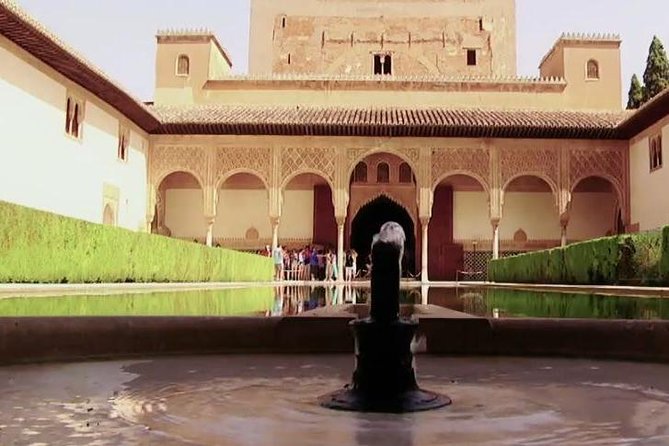
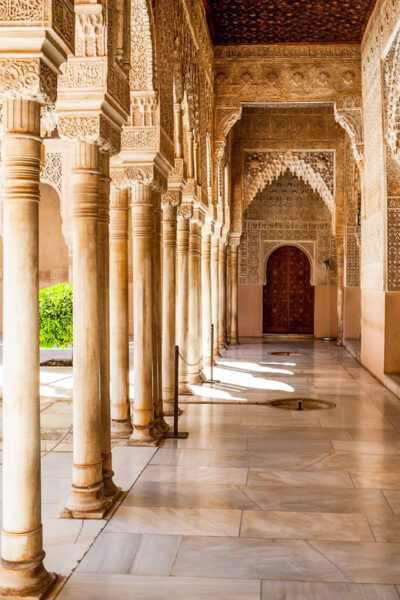
The Palace of Comares is arranged around the Courtyard of the Myrtles, also called the Patio de los Arrayanes. The long pool, clipped myrtles, and reflected architecture create one of the Alhambra’s most memorable views.
Water is not just decoration here. It cools, reflects, and slows the eye. A guide can help you notice how the courtyard frames the surrounding walls and how the pool turns the building into a kind of moving picture.
From the courtyard, you reach the Hall of Ambassadors and the Hall of the Boat. The Hall of Ambassadors sits inside the Tower of Comares and served as an important royal reception room. This is the sort of place where a short explanation of symbols, inscriptions, and political ceremony adds far more than another minute spent taking photographs.
The Palace of the Lions
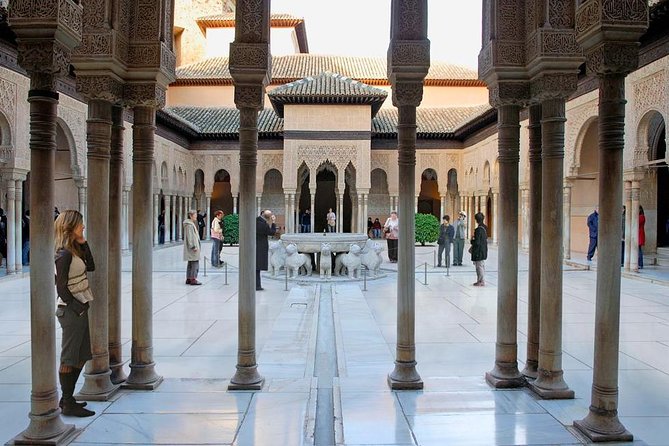
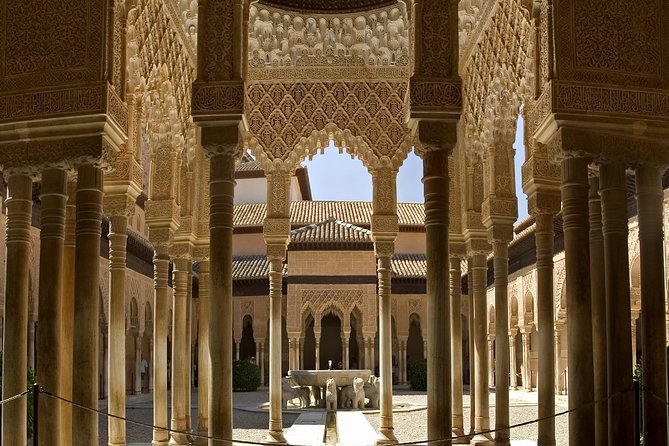
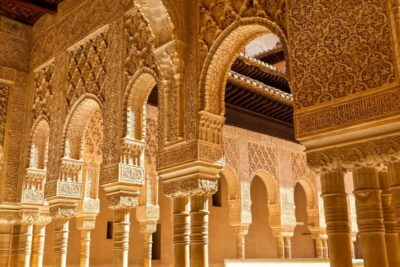
The Palace of the Lions dates from the era of Muhammad V. Its central Courtyard of the Lions is surrounded by rooms including the Hall of the Mocarabes, Hall of the Kings, Hall of the Two Sisters, Hall of the Ajimeces, Hall of the Abencerrajes, and the Harem.
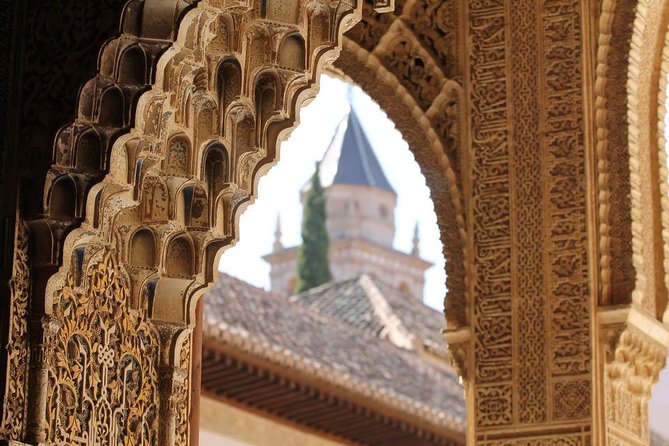
The famous lion fountain is the visual center, but the surrounding rooms deserve patience. Look upward at the ceilings, then move your eyes to the walls and floor tiles. The Alhambra’s power comes from the way many small design choices work together, rather than from one giant object.
The Mirador Daraxa viewpoint, reached through the Hall of the Ajimeces, offers another carefully controlled view. These rooms show how the palace used framed openings, filtered light, water, and ornament to shape a visitor’s movement.
This is also where a guide makes the largest difference. The palace is crowded, and you may have only a short time to look before the group moves on. Guides such as Carlos, Alberto, Emilio, and Jenny have been praised for making busy rooms feel more personal, answering questions, and adding humor or legends to the formal history.
The Alcazaba fortress and the best views
The Alcazaba is the oldest part of the Alhambra complex and the most clearly military. Its walls, towers, and elevated position remind you that this was a fortress before it became famous as a palace.
The contrast with the Nasrid rooms is welcome. After ornate courtyards and delicate plasterwork, the Alcazaba feels harder and more practical. The views across Granada and toward the surrounding mountains are a major reward, though reaching them involves hills, steps, and uneven walking.
Several visitors have described the route as physically demanding. You should be comfortable walking uphill and climbing stairs for much of the three-hour visit. If you have asthma, a leg injury, or another condition that affects your pace, tell the operator before the tour begins and confirm how the guide handles slower participants.
The guide’s job here is partly practical. Keeping a group together on a crowded hilltop site is not glamorous, but it matters. Fernando has been singled out for being organized and attentive, while Antonio has been praised for stopping at useful photo points with a small group.
Generalife Gardens and the summer palace
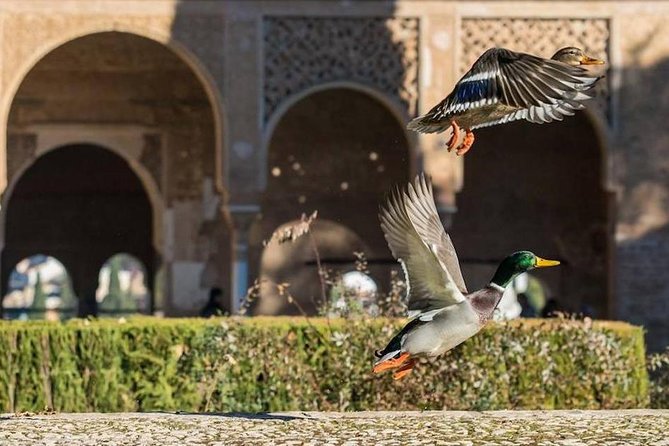
The Generalife was a country estate and agricultural property used by the Nasrid sultans. It sits beyond the main Alhambra walls on Cerro del Sol and served as a summer retreat.
The gardens provide a different rhythm from the palaces. Instead of enclosed rooms and layered decoration, you get open courtyards, water channels, clipped shrubs, flowers, trees, and views across the surrounding area. The Patio de la Acequia is especially important, with its long water channel and planted borders. The Patio de la Sultana adds another garden setting tied to royal leisure.
The guide may point out particular flowers, fruit, herbs, and trees. That can be a pleasant change from dates and dynasties, especially if you enjoy gardens. It can also take too much time if your main reason for booking is the Nasrid architecture. One poor experience described the first hour as focused heavily on familiar plants, with the palace section providing the most useful explanation.
I would treat the Generalife as an essential part of the visit, but listen for the balance. The gardens explain how the sultans escaped the formal palace and used water and planting to create a cooler summer setting. They are not simply a pretty add-on.
Group size, language, and the guide you get
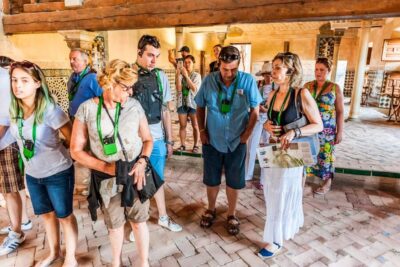
The advertised maximum is 15 people, and the small-group option is meant to give you more access to the guide than a standard large coach group. That smaller size is valuable in the Nasrid Palaces, where you need to hear explanations without losing sight of the guide.
There is an important warning here. Some departures have apparently been combined into groups of around 30, despite the stated small-group limit. If the group is larger than expected, the guide may spend more time counting heads and moving everyone along. Before paying, confirm that the option you select is the small-group or private version and ask the provider to confirm the maximum.
Language can also shift. The tour is offered in English, but some departures have been run bilingually in English and Spanish, or English and German, when numbers were too low for a single-language group. That can add a lot of extra standing and listening time. If a fully English tour matters to you, confirm this in writing before the day of the visit.
The named guides associated with the strongest experiences include Eduardo, Fernando, Consuelo, Carlos, Andy, Alberto, Emilio, Maria, Jenny, Antonio, and Angela. That does not guarantee a particular guide, but it gives you an idea of the qualities to hope for: clear speech, strong subject knowledge, humor, patience, and a good eye for stopping points.
Timing problems you should take seriously
The Alhambra controls visitor numbers, and the Nasrid Palaces have especially strict timed entry. Because of this, the operator may move the meeting time earlier to protect access to the palace section.
That has caused serious problems for people who relied on the original time shown in their booking reminders. A tour once scheduled for noon was moved to 10 a.m., while some automated reminders still showed noon. A missed palace time may leave you with a ticket but no guided visit, or with an audio option that does not work properly.
Arrive early at the meeting point on P.º de la Sabica, 15. Check your messages in the booking platform, email, and phone before leaving your hotel. If the time changes, save the updated notice and contact the operator directly.
You also need to provide the full name and passport details of each participant when booking. The Alhambra may deny entry if these details are missing. Bring the required physical identification as instructed, since missing documents can delay the entire group.
Late arrival is a real risk. One account involved arriving 30 minutes late and missing the guided connection to the Nasrid Palace time. With a site this tightly scheduled, the guide may not be able to hold the group.
Is $107.63 a fair price?
At $107.63 per person, this is not a bargain admission ticket. You are paying for reserved entry, a guide, and the convenience of having the major sections organized into one route.
The price makes more sense if you value explanation and want to avoid arranging separate tickets for the Nasrid Palaces, Alcazaba, Carlos V Palace, and Generalife. A private option can also be worthwhile for families or couples who want to ask many questions and set a more personal pace.
The value drops if your departure becomes a large group, turns bilingual, runs shorter than the advertised three hours, or loses the live guide because of a timing problem. One visit was described as closer to two hours, so I would treat three hours as approximate rather than guaranteed.
Food, drinks, transportation, and headphones are not included. You need to make your own way to the meeting point, and the tour ends there. Granada’s public transportation is nearby, but the experience itself involves substantial walking once inside the complex.
The cancellation policy is strict: the activity is non-refundable and cannot be changed for any reason. That makes it wise to book only after your Granada schedule is firm.
Who should book this Alhambra tour?
I would choose this tour if you want the major sights explained in one visit and do not want to manage the Alhambra’s complicated ticket system alone. It suits first-time visitors, families who benefit from storytelling, and anyone who wants help noticing inscriptions, decorative details, gardens, and the relationship between the Moorish and Christian buildings.
A private departure is the best fit if you want to set the pace or ask many questions. The small-group version can offer good value, but confirm that the group will really stay within the stated limit.
I would be cautious if you need a slow walking pace, a guaranteed single-language tour, or complete control over timing. The operator’s schedule can change, and the route is not gentle on tired legs. If you book, check the updated meeting time repeatedly and arrive early.
Should you book it?
Yes, if your priority is a guided overview of the entire Alhambra with reserved entry to the Nasrid Palaces. The site itself is extraordinary, and guides such as Eduardo, Fernando, Consuelo, and Carlos have shown how much better the visit can be when someone explains the rooms, gardens, inscriptions, and legends as you go.
Book with care. Confirm the group size, language, and final start time. Bring the identification details required for entry, wear shoes suited to hills and steps, and allow enough time to reach the meeting point early. For many people, the convenience and historical context justify the price, but the experience depends heavily on good communication and a properly managed group.
FAQ
Where does the Alhambra tour start?
The meeting point is P.º de la Sabica, 15, Centro, 18009 Granada, Spain.
Where does the tour end?
The activity ends back at the meeting point.
How long does the tour last?
The advertised duration is approximately three hours. One account described a visit lasting closer to two hours, so the actual timing can vary.
What parts of the Alhambra are included?
The tour includes the Palace of Carlos V, Nasrid Palaces, Alcazaba fortress, and Generalife Gardens.
Are the Nasrid Palaces included?
Yes. Reserved entry covers the full Alhambra complex, including the Nasrid Palaces.
Is transportation included?
No. Transportation to and from the Alhambra is not included.
Are food and drinks included?
No. Food and drinks are not included unless specifically stated.
Are headphones provided?
No. Headphones are not included.
What identification details are needed?
The Alhambra requires the full name and passport details of every participant when booking. Missing information may result in denied entry.
How large can the group be?
The stated maximum is 15 people. Because some departures have been combined into larger groups, confirm the group size when booking the small-group option.
Recently added in Granada
- Granada City Center and Albaicin Private Tour★ 5.0 · 181 reviews
- Alhambra & Generalife Tour including Transport & Admission★ 4.3 · 187 reviews
- Granada full day: La alhambra completa + el Albaicin y Sacromonte★ 5.0 · 188 reviews
- Alhambra, Nasrid Palaces, Generalife & Alcazaba Private Tour★ 5.0 · 190 reviews
- Private Tour to The Alhambra with Nasrid Palaces in Granada★ 5.0 · 192 reviews
- Granada: Albaicin and Sacromonte Private Tour★ 5.0 · 197 reviews
- Zooming Through Granada: A Fun-Filled Electric Bike Tour★ 4.5 · 201 reviews
- Granada: Moorish Monuments Entrance Tickets★ 3.7 · 203 reviews
Alhambra & Nasrid Palaces Tours, compared.
Alhambra & Gardens Tour w/Nasrid Palaces Option
Read the review →
Alcazaba and Roman Theatre Guided Tour With Entry
Read the review →
Fast-Track Alhambra & Nasrid Palaces Guided Tour
Read the review →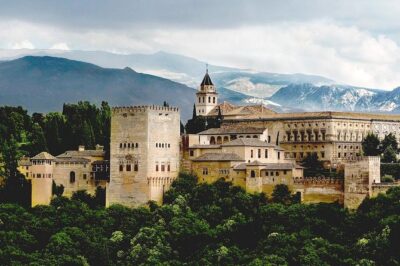
Skip The Line Alhambra and Generalife Guided Tour
Read the review →
Alhambra Ticket and Guided Tour with Nasrid Palaces
Read the review →Browse the lists this tour appears in