
Reviewed · CADIZ TOURS
Andalusian Horses Dance Show
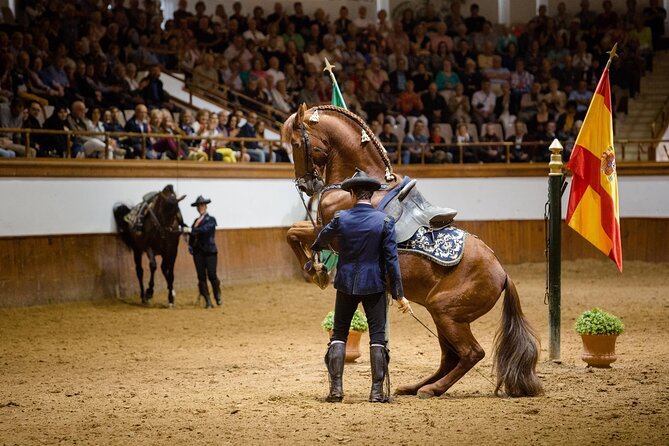
Andalusian horses do far more than trot in circles. At Jerez’s Royal Andalusian School of Equestrian Art, they perform precise dressage, dramatic leaps, carriage work, and the old cattle-herding style known as doma vaquera. The horses move to classical music, often with such light signals from the rider that the performance can look like a ballet.
I like the range of riding styles and the chance to see both horses and carriages in action. I also like that this is a family-friendly experience with a clear 90-minute running time. The main caution is seating: tickets are sold by category, not by exact row or seat, and some positions can have a restricted view. Commentary is also in Spanish, which can make the technical parts harder to follow.
Key points to know before you book
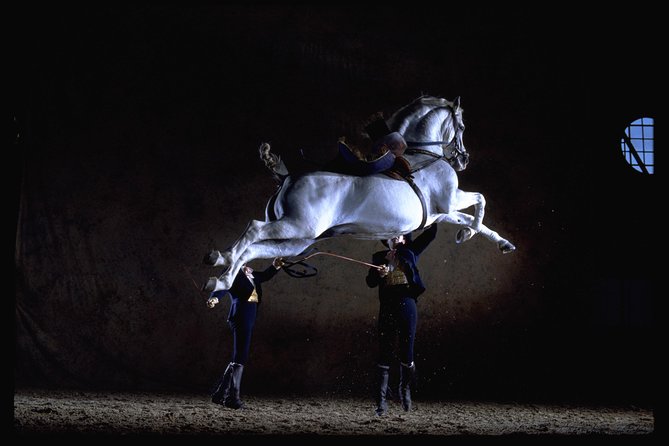
- Six to eight choreographies: The program can include doma vaquera, classical dressage, carriage driving, work in hand, and a final carrousel.
- A Jerez tradition: The show takes place at the Royal Andalusian School of Equestrian Art, one of the city’s signature attractions.
- Seat choice is limited: You buy a price category, but the school assigns your row and seat.
- Higher seats can help: A raised position gives a better view of the full arena, while some lower seats may see less of the action.
- Plan extra time: Arrive 30 to 45 minutes early if you want to see the grounds, warm-up activity, cafe, or shop.
- Bring the right ticket: You must present a printed receipt at the ticket office, and discounted tickets require proof of eligibility.
Why this horse show feels different
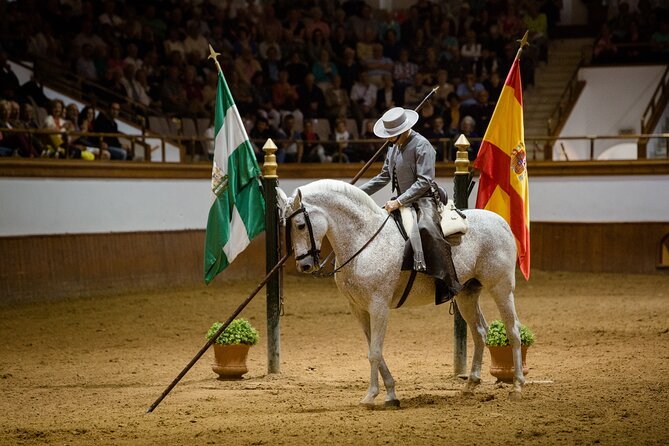
The show is not simply a parade of pretty horses. Its appeal comes from the control, training, and variety packed into a relatively short performance.
The Andalusian horse is presented as an athlete and a partner. Riders use small movements to ask for changes in pace, turns, elevated steps, and jumps. The best moments are often the quiet ones, when the horse seems to respond before you can see what the rider has done.
The program changes by day. Each performance uses six to eight choreographies from the school’s repertoire, with similar levels of difficulty and entertainment value. That means you should expect a well-rounded display, but not assume that every visit follows the exact same order.
The setting also matters. You are watching inside the institution that trains and presents these horses, rather than at a temporary tourist show. That gives the performance a stronger connection to Andalusian equestrian culture, especially in Jerez, a city known for its horses, sherry, and traditional riding.
More horse rides in Cadiz:
- Cadiz: Andalusian Horses and Bulls Country Show
★ 4.6 · 189 reviews - Jerez de la Frontera: How the Andalusian Horses Dance
★ 4.6 · 6,168 reviews - El Salobre: Horse Riding Adventure with Transfer Options
★ 4.5 · 1,609 reviews
At the Royal Andalusian School in Jerez
Your visit begins at the Royal Andalusian School of Equestrian Art on Avenida Duque de Abrantes. The start time provided for this experience is noon, and the performance lasts about one hour and 30 minutes.
Present your printed receipt at the ticket office to collect admission. Do not rely only on a phone voucher, since the instructions specifically require a printed receipt. If you have bought a reduced-price ticket, carry the required proof of eligibility. Without it, you may need to pay the difference to the full standard price, assuming full-price tickets are still available.
Give yourself extra time before the show. Thirty to 45 minutes allows you to find the correct entrance, sort out the ticket collection, and look around without rushing. The grounds include a cafe and shop, and you may be able to watch horses and riders warming up before the main performance.
The school is near public transportation, but the location can cause confusion if you are traveling by train. Check that you are heading to Jerez de la Frontera and not another nearby town or stop with a similar name. A wrong arrival point can turn a simple visit into an expensive taxi ride.
Doma vaquera: riding shaped by cattle work
Doma vaquera is one of the most distinctly Spanish sections of the show. It developed from the practical riding methods used by cattle herders, so it has a more working-ranch feel than formal dressage.
The horseman rides with one hand while guiding the horse around the arena. You may see a change from a trot to a gallop, sudden shifts in rhythm, tight pirouettes, and arreones, in which the horse breaks sharply into a gallop.
This part is valuable because it shows where some of the riding tradition comes from. It is not only about polished presentation. The movements suggest a rider who needs a responsive horse while handling cattle, changing direction quickly, and working with one hand on the reins.
If you have only seen English-style dressage, doma vaquera gives the show a different character. It feels faster and less formal, with bursts of speed that keep children interested. The performance still depends on precision, but the purpose behind the movements is easier to picture.
Classical dressage and the quiet art of control
Classical dressage forms the graceful center of the performance. Horses work to classical music while performing advanced exercises that require balance, strength, and careful timing.
The repertoire can include:
- The Colts
- Airs on Horseback
- Pas de Deux
- Passage and Piaffe
- Domino on Horseback
- Airs Above the Ground
- Fantasy
Passage and piaffe are especially useful terms to know before you arrive. Passage is a highly collected, elevated trot with a measured rhythm. Piaffe is performed almost in place, with the horse lifting its legs while maintaining balance and control.
The airs above the ground are the showier part of classical training. Depending on the program, you may see movements such as levades, caprioles, or courbettes. These require the horse to lift the front of its body or make a powerful jump, and they are the moments most likely to draw gasps from the audience.
You do not need to understand dressage terminology to enjoy this section. Watch the relationship between rider and horse. The horse appears calm, while the rider stays centered and gives instructions with very little visible effort. That quiet partnership is often more impressive than the bigger tricks.
The downside is the explanation. Announcements may be made in several languages, but the descriptions before each section can be in Spanish only. You can still follow the action, though an English explanation would help you understand what each movement requires.
A few other Cadiz outings to compare
- Seville: Live Flamenco Dancing Show Ticket at the Theater
★ 4.7 · 16,396 reviews - Seville: Casa de la Memoria Flamenco Show
★ 4.8 · 12,964 reviews - Madrid: Live Flamenco Show with Food and Drinks Options
★ 4.5 · 9,901 reviews - Barcelona: Flamenco Show at the Theater
★ 4.5 · 8,442 reviews
Carriage driving brings an older skill into the arena
The carriage-driving section changes the pace and scale of the show. Instead of carrying a rider, the horses pull carriages while coachmen handle the traditional harness.
These carriages were once used for transport and are now presented as a sport and exhibition skill. The coachmen guide multiple horses and the vehicle through the arena with careful timing. You get to watch not only the horses but also the coordination between the driver, harness, carriage, and team.
This is a good reminder that equestrian art is broader than riding. The horses must respond to direction from behind rather than from a rider seated on their backs. The movement of the carriage adds another layer of precision, especially when the team changes direction or works through a pattern.
For children, this section offers a welcome visual change. For adults, it shows how much technical skill is involved in a form of transport that now survives mainly in sport and ceremony.
Work in hand and the final carrousel
Work in hand is one of the more unusual parts of the program. The rider is on the ground rather than in the saddle, yet the horse follows commands to perform classical Haute École exercises.
The horse may execute levades, caprioles, courbettes, piaffe between pillars, the Spanish walk, and long-rein work. Seeing the animal respond without a rider’s weight gives you a clearer view of the communication between horse and handler.
The Spanish walk is easy to recognize, with the horse lifting its front legs in an exaggerated, deliberate step. The elevated movements are more dramatic, but the central idea remains the same: control without forceful-looking signals.
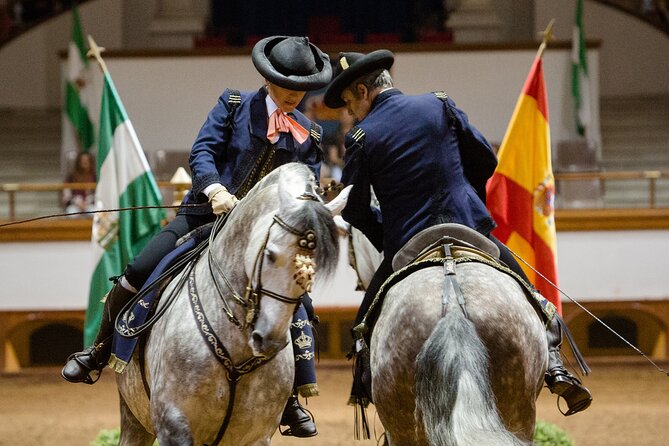
The carrousel provides the closing display. Several horses and riders work together in unison, performing advanced exercises in the center of the arena. Group choreography is difficult because every rider must keep pace, position, and distance while also managing an individual horse.
It makes a fitting finale because the show moves from individual skill to teamwork. The final image is less about one spectacular jump and more about several horse-and-rider pairs functioning as one organized group.
Seating can shape the whole experience
The ticket system deserves close attention. Admission is sold by price category, but you do not select a precise row or seat number. Seats are assigned according to the order of purchase or booking.
That arrangement creates a real difference between a good seat and a merely acceptable one. Some people have received positions with part of the arena blocked or difficult to see. If you cannot see one quarter of the ring, even a fine performance loses some of its value.
A higher position can give you a better view of the full patterns, especially during the carrousel and carriage work. A front-row seat puts you close to the horses and makes the animals feel impressively large, but it may not give you the broadest view of formations.
When booking, treat the seating category as an important part of the price. If you care most about seeing every movement, a better category may be worth paying for. If you are content to focus on the horses at close range, a lower position can still be enjoyable, provided it is not restricted.
Price, timing, and getting to Jerez
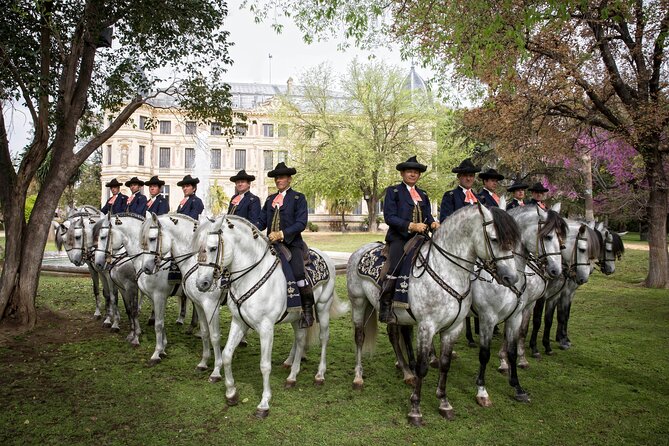
At about $33.43 per person, this is a moderate-priced attraction rather than a quick free-time stop. The value depends on how much you care about horses, dressage, and traditional Andalusian performance.
I consider it good value if you are already planning time in Jerez. You get a full 90-minute show, access to a highly specialized performance, and the chance to see several disciplines in one sitting. It is also a strong choice for families because the action keeps changing and the running time is manageable.
The value is less clear if you must pay for a long taxi ride or make a difficult day trip only for the show. From Cádiz, plan your transport carefully. From a cruise port, a taxi can take roughly 30 to 40 minutes and may cost more than expected, particularly if the driver waits during the performance. Confirm the fare before setting off, and consider a ride service where available.
By train, the trip from Seville can work well, but check the correct town and stop before leaving. Arriving early gives you time to reach the school and see the grounds without cutting the timing close.
Parking is available nearby, but be cautious around people who signal cars toward spaces or request payment. Some nearby parking is free, and you should confirm the official arrangement rather than handing over money automatically. The ticket window can also be confusing, so allow time to ask where prepaid tickets are collected.
Heat, language, and other practical details
The arena can become warm in summer. Bring a fan and dress for the conditions, particularly if you are sensitive to heat. The show itself is indoors or arena-based, but that does not guarantee a cool environment.
Photography, video, and recording are not allowed unless you are an authorized professional. Leave bottles, cans, animals, and objects that management considers unsuitable outside the grounds.
The performance provider may change the program. That is normal for a repertoire-based show, and the exact selection of choreographies is not guaranteed. You should book this for the overall equestrian experience, not one specific movement.
The show is suitable for most people, and it does not require riding knowledge. Horse lovers will notice more detail, but you can appreciate the music, costumes, movement, and group patterns without knowing the technical names.
The experience does not include admission to other facilities. If you want to visit additional parts of the school or grounds beyond what is included with the performance, check the arrangements separately.
Free cancellation is available if you cancel at least 24 hours before the local start time. Changes or cancellations made less than 24 hours ahead are not accepted for a refund.
Should you book the Andalusian Horses Dance Show?
Book it if you want a distinctly Andalusian activity that combines sport, music, ceremony, and trained animals. It is especially worthwhile for horse lovers, families, fans of classical dressage, and anyone spending a full day in Jerez.
I would also recommend it to people who normally skip staged attractions but want to understand an important local tradition. The doma vaquera, carriage driving, work in hand, and carrousel make this more varied than a single-style riding demonstration.
Think twice if you dislike formal performances, have a strict budget for transport, or need detailed English narration. Also be careful with seating expectations. Since exact seats are not selected, ask about the ticket category and possible viewing limits before committing.
For most visitors who can reach the school without a costly transport problem, the 90-minute show offers a memorable look at the skill and patience behind Andalusian horsemanship. Plan ahead, arrive early, protect yourself from the heat, and treat the seating category as part of the buying decision.
FAQ
Where does the Andalusian horse show take place?
The show takes place at the Royal Andalusian School of Equestrian Art, Avenida Duque de Abrantes, Jerez de la Frontera, Cádiz, Spain.
What time does the experience start?
The listed start time is 12:00 pm.
How long does the performance last?
The show lasts approximately one hour and 30 minutes.
What riding styles are included?
The repertoire can include doma vaquera, classical dressage, carriage driving, work in hand, and a final carrousel. Each performance uses six to eight choreographies, and the program can change by day.
Can I choose my exact seat?
No. Tickets are sold by price category, while the row and seat number are assigned according to the order of purchase or booking. Some seats may have a restricted view.
What must I bring to collect my ticket?
You must present a printed receipt at the ticket office. If you bought a discounted ticket, you must also show proof that you qualify for the discount.
Recently added in Cadiz
- Cadiz: Andalusian Horses and Bulls Country Show★ 4.6 · 189 reviews
- Cadiz: Guided City Tour★ 4.6 · 204 reviews
- Cadiz: City Bike Tour★ 4.8 · 209 reviews
- Cadiz: Highlights Tour by Segway★ 4.6 · 212 reviews
- Cadiz Small Group Bike Tour★ 4.5 · 215 reviews
- Sancti Petri: Sunset Catamaran Cruise★ 4.5 · 277 reviews
- Cádiz: Bay of Cádiz Catamaran Tour with Host★ 4.4 · 327 reviews
- Cadiz: Medieval Tour★ 4.6 · 379 reviews
Cadiz Tours, compared.
Walking Tour through Cádiz: Stories from the hand of a local guide
Read the review →
English Cádiz Tour: Walking Tour with Local Guide
Read the review →
Browse the lists this tour appears in