
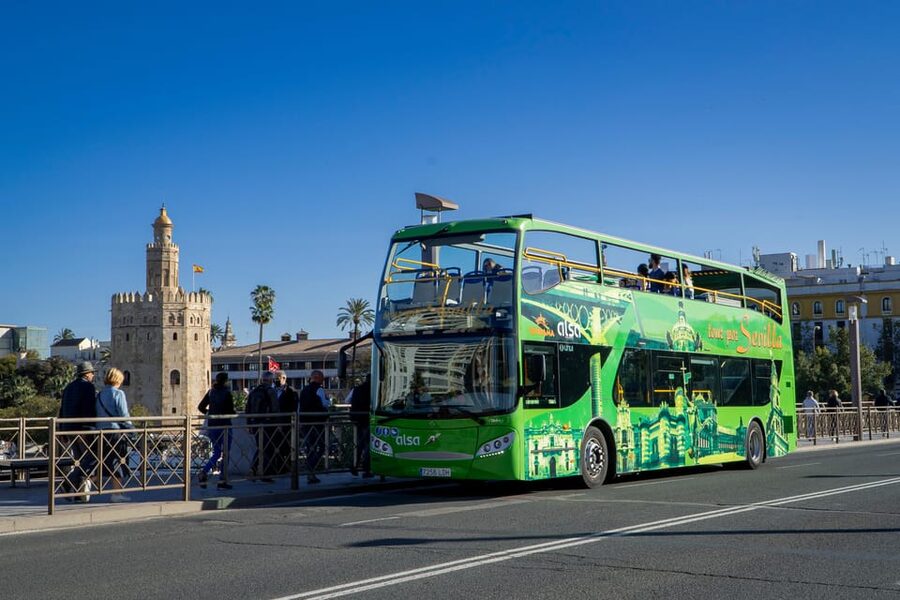
Reviewed · SEVILLE TOURS
Seville: 2-Day Hop-on Hop-off Bus Ticket
Seville makes a strong first impression from the top deck of a bus. From Torre del Oro, you sweep past the Guadalquivir, Plaza de España, María Luisa Park, the old walls near Macarena, and the former monastery of Cartuja without spending your first morning working out the city map. The two-day ticket is the main attraction here. It gives you time to ride the full loop, then return for proper stops instead of cramming Seville into one hurried circuit.
I like the 14-stop route and the freedom to get off whenever a tiled plaza or grand building catches your eye. I also like the included walking tours of Santa Cruz and Triana, since the bus gives you the broad view but your feet show you the narrow streets. The main drawback is the recorded commentary. It can be out of sync with the sights, and one report found that stop numbers, WiFi, and the onboard screen were not always working as expected.
Key points to know before you board
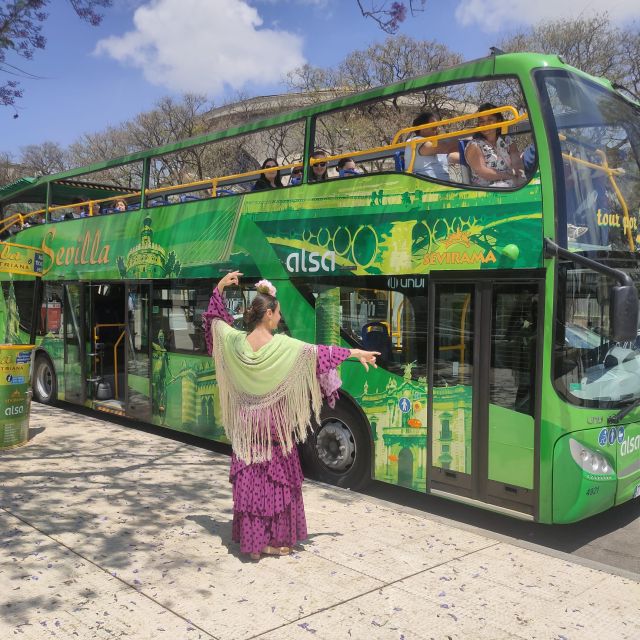
- Two consecutive days: Activate the ticket once, then ride and hop off as often as you like during the next two days.
- Fourteen stops: The loop links Torre del Oro, Plaza de España, Cartuja, Isla Mágica, Macarena, Plaza de Armas, and more.
- A 75-minute full circuit: Stay aboard for the complete route when you want an overview, or use the bus as a sightseeing shuttle.
- Two neighborhood walks: Santa Cruz and Triana are included, with two walking tours each day.
- Open-top views in all seasons: Buses have both heated and air-conditioned areas, though the upper deck is exposed.
- Eight audio languages: Commentary is available in Spanish, English, French, German, Italian, Russian, Dutch, and Portuguese.
Why two days makes a real difference
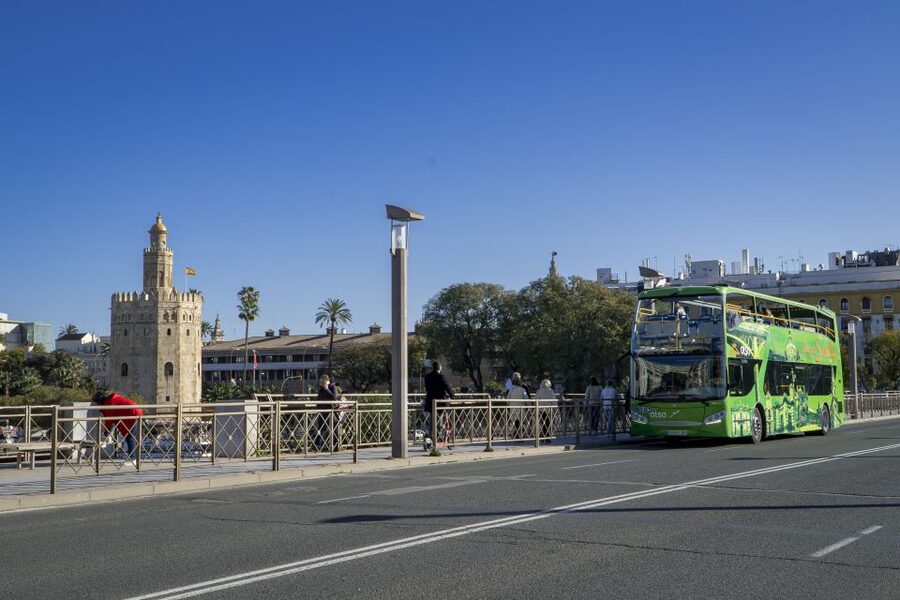
A one-day bus ticket can be useful, but Seville is better served by two. The complete circuit takes about 1 hour and 15 minutes, and that is before you stop for photos, a snack, a museum, or a long look at Plaza de España. With only one day, you may spend most of your time riding and waiting. With two, you can use the first day to get oriented and the second to revisit the places that deserve more time.
The pass is valid for two consecutive days from first activation. You can board at Torre del Oro, ride part of the circuit, get off, and later rejoin the route. A practical approach is to take the full loop early, note the stops that interest you, and then use the rest of the ticket for short hops.
The bus has been reported to arrive about every 15 minutes, which makes this format more useful for casual sightseeing. Still, I would not plan a tightly timed restaurant booking around an exact bus arrival. Traffic, loading time, and the length of each stop can alter the rhythm.
At $32 per person, the value depends on how you use the pass. It is not a bargain if you remain on the bus for one loop and spend the rest of your visit walking. It becomes more useful if you ride on both days, make several hops, and join the Santa Cruz and Triana walks. You are paying for transport, a city overview, recorded commentary, and flexibility in one ticket.
A few other Seville outings to compare
- Granada City Train 1 or 2-Day Hop-On Hop-Off Ticket
★ 3.5 · 3,128 reviews
Starting at Torre del Oro
Torre del Oro is a sensible starting point. This sturdy riverside tower gives you an immediate sense of Seville’s setting, with the Guadalquivir beside you and the city spreading inland. It is also a clear landmark, which helps if you are meeting the bus for the first time.
From here, the route gives you a broad introduction rather than a detailed visit to every monument. The bus passes the Seville Aquarium, then heads toward the southern part of the city. If you have just arrived, this first section helps you understand how the river, parks, university buildings, and central districts fit together.
You should bring headphones if you prefer your own pair, but headphones are included. WiFi is also listed as available on the bus. One important practical note: onboard systems may not always perform perfectly. Commentary has sometimes lagged behind the buildings outside, and the screen or WiFi may be unavailable on a particular ride.
Plaza de América and Plaza de España
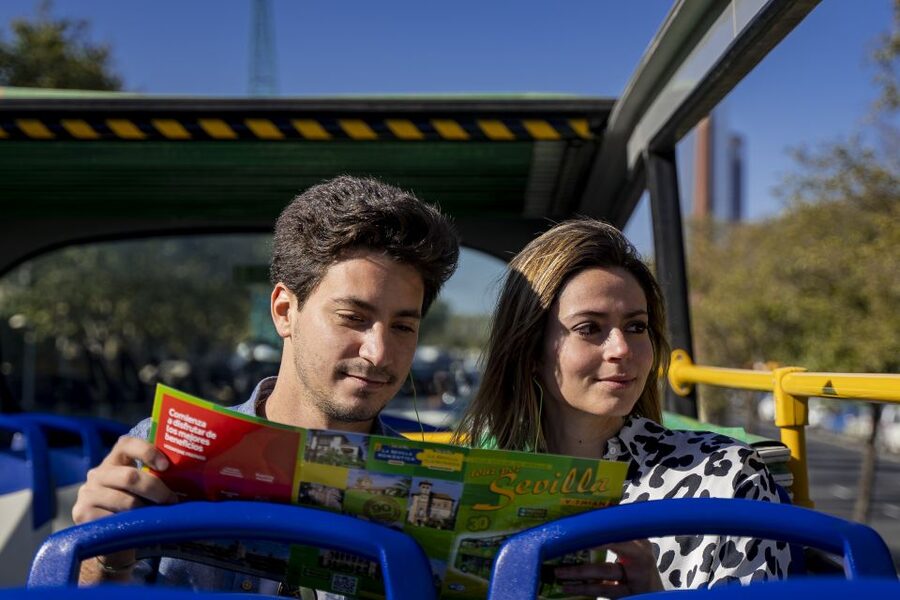
The route passes Plaza de América and Plaza de España, two of the most rewarding sights in Seville. Both sit beside Parque de María Luisa, where broad paths, tiled details, fountains, and shade make a break from the traffic useful.
Plaza de España is especially impressive from the road, but a quick pass is not enough. If you have never seen it before, get off and walk around the curved building, bridges, and tiled alcoves. The bus gives you the useful first look. Your own visit gives you the details.
The University of Seville follows on the route. Its building occupies the former Royal Tobacco Factory, a huge complex with an important place in the city’s past. From the bus, you get the scale of the structure more than its interiors. If architecture interests you, note the stop and allow extra time nearby.
This southern stretch is one reason the upper deck is worthwhile. You can take in the larger arrangement of Seville without constantly turning your head at street level. On a hot day, however, the shaded or lower deck may be the better choice, especially if you are riding the whole loop.
Crossing the Guadalquivir toward Triana
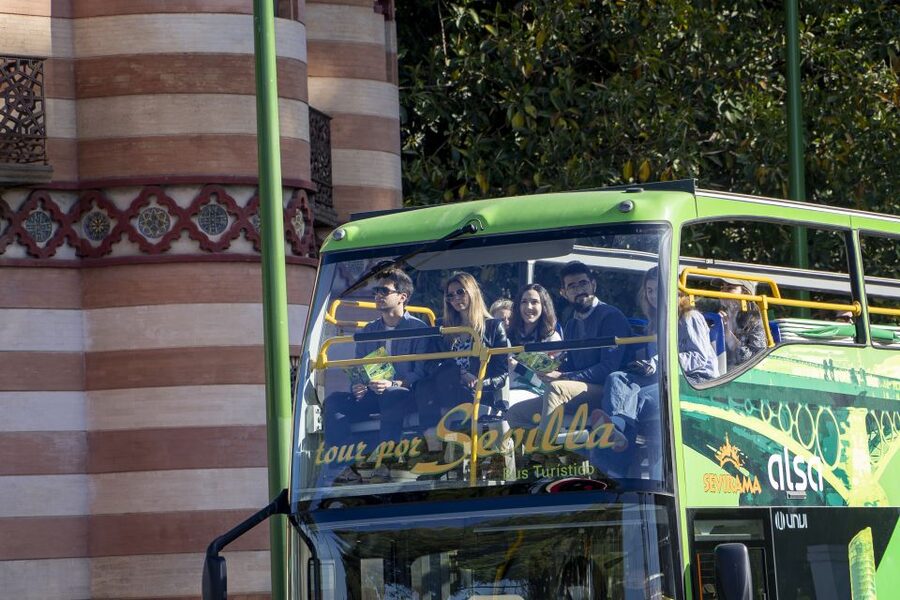
The route continues to Plaza de Cuba, then crosses toward Triana and the western side of the city. You make two crossings of the Guadalquivir during the circuit, a simple feature that gives the ride some variety and helps you see Seville from both riverbanks.
Triana has a personality distinct from the monumental center. It is associated with ceramics, river life, and lively neighborhood streets, though the bus itself can only offer a passing view. This is where the included walking tour matters. The bus shows you the outline. The walking tour lets you explore at street level.
The route passes San Jacinto and the Puente del Cristo de la Expiración. The bridge carries you back toward the area of Cartuja. You might find this section less packed with famous postcard sights, but it is useful for seeing how far Seville extends beyond the cathedral and palace district.
If you want the best views, sit upstairs when the weather is kind. If rain arrives, stay below and use the audio. One useful feature of this ticket is that a wet first day does not have to ruin the experience. You can remain aboard, listen to the commentary, and save your stops for the following day.
Same city, a completely different evening:
- Seville: Royal Alcázar Entry Ticket
★ 4.6 · 28,378 reviews - Seville: Cathedral and La Giralda Entry Ticket
★ 4.5 · 24,592 reviews - Seville: Live Flamenco Dancing Show Ticket at the Theater
★ 4.7 · 16,396 reviews - Seville: Casa de la Memoria Flamenco Show
★ 4.8 · 12,964 reviews
Cartuja and Columbus’s Seville
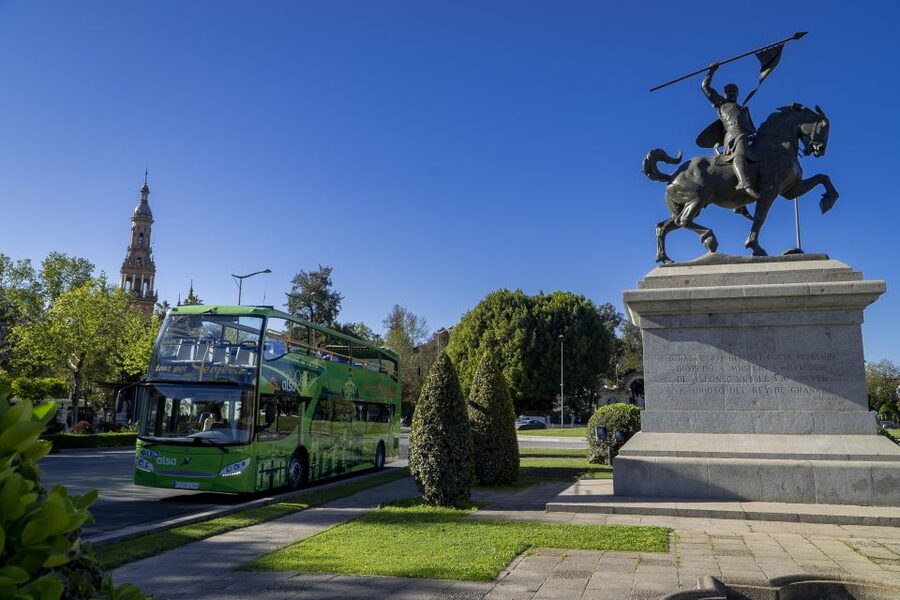
The Monasterio de la Cartuja is one of the route’s more unusual sights. Cartuja is tied to Christopher Columbus, who lived there before his voyage of discovery. The bus lets you see the area without making a special cross-city trip, and you can get off if you want to give the monastery and surrounding island more attention.
This part of Seville often feels less immediately familiar than Plaza de España or the Macarena. That is exactly why the bus is useful here. It links places that may not form an obvious walking route for a first-time visitor.
The road then reaches Ciudad Expo, followed by Isla Mágica. These stops are more practical than picturesque for many visitors. Isla Mágica may interest families or anyone planning a separate visit, while Ciudad Expo is mainly a reminder that the route covers more than the historic core.
I would not choose this bus solely for these western stops. I would choose it because they are included in a wider circuit that also covers the city’s major sights. The value comes from the complete picture, not from treating every stop as a must-see attraction.
Macarena walls and the northern route
The bus next passes the Almohad walls near Macarena, one of the clearest reminders of Seville’s Islamic past. The walls are not just background scenery. They help explain the shape of the old city and the defensive edge that once protected it.
Nearby is the Basilica of La Macarena, devoted to one of Seville’s best-known images of the Virgin Mary. The route description identifies it as the city’s most famous church connected with the Virgin Mary. If religious art and local traditions interest you, this is a good place to leave the bus rather than simply watch it pass.
The bus then moves toward Plaza del Duque de la Victoria. This is a useful central stop for shopping streets, city wandering, and a return toward the main sights. It can also serve as a practical break between the northern section and the final part of the circuit.
The route ends its main loop around Plaza de Armas before returning toward Torre del Oro. Plaza de Armas is a useful transport area, but not every stop has the same sightseeing value. Think of some stops as destinations and others as convenient points to leave or rejoin the bus.
Two walking tours, Santa Cruz and Triana
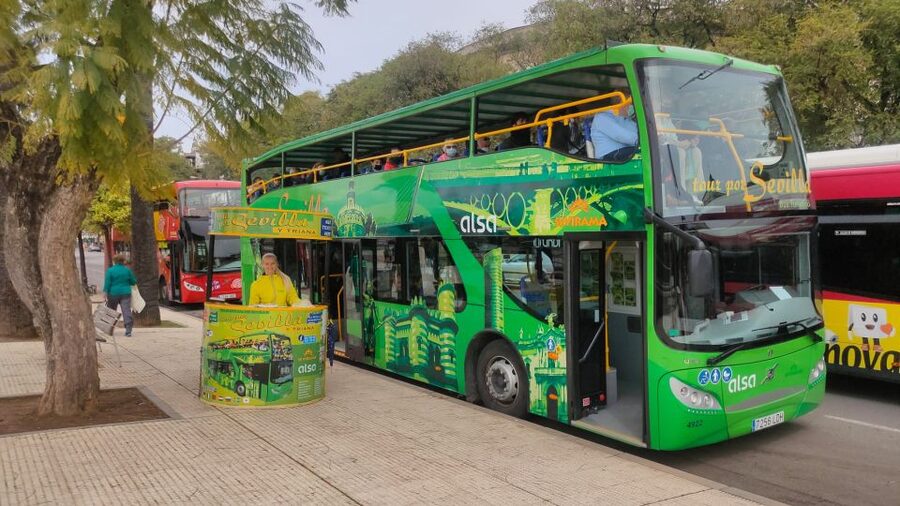
The included walking tours are an important part of the ticket. They are offered in Santa Cruz and Triana, with two walking tours each day. Exact tour length and departure details are not provided, so confirm the day’s times when you activate your ticket.
Santa Cruz is the old Jewish quarter, with tight lanes, small squares, and the kind of layout that makes a street guide useful. A bus cannot enter or explain this area properly. Walking gives you time to notice the walls, balconies, tiled surfaces, and sudden open spaces.
Triana offers a different mood across the river. The neighborhood is closely linked with ceramics and local traditions, and its streets reward a slower pace. Combining the bus ride with the walk is a smart use of your ticket: ride over, explore on foot, and then use the bus to continue elsewhere.
Do not treat the walks as a substitute for a full private guide. They are included orientation tours, not a custom itinerary. Their value is that they add human-scale context to a ticket otherwise built around transport and recorded narration.
Audio commentary and comfort on board

The recorded commentary is available in eight languages: Spanish, English, French, German, Italian, Russian, Dutch, and Portuguese. English announcements identify stops and points of interest, which can make the route easier to follow when the bus is moving through unfamiliar streets.
The commentary is not flawless. It may be out of sync with the landmark outside, and some sights may pass without a detailed mention. I would use it as a helpful layer, not as your only source of information. Keep the route map in hand and watch for the places you want to revisit.
The buses have heated and air-conditioned sections, which matters in Seville’s changing weather. The open upper deck gives you the best 360-degree view, but it also leaves you exposed to sun and rain. The lower deck is less scenic but more comfortable when conditions turn unpleasant.
The bus is adapted for people with reduced mobility. Smoking is not allowed, and pets are not permitted, except for assistance dogs. These simple rules make the ride easier for everyone.
Who gets the best value from this ticket?
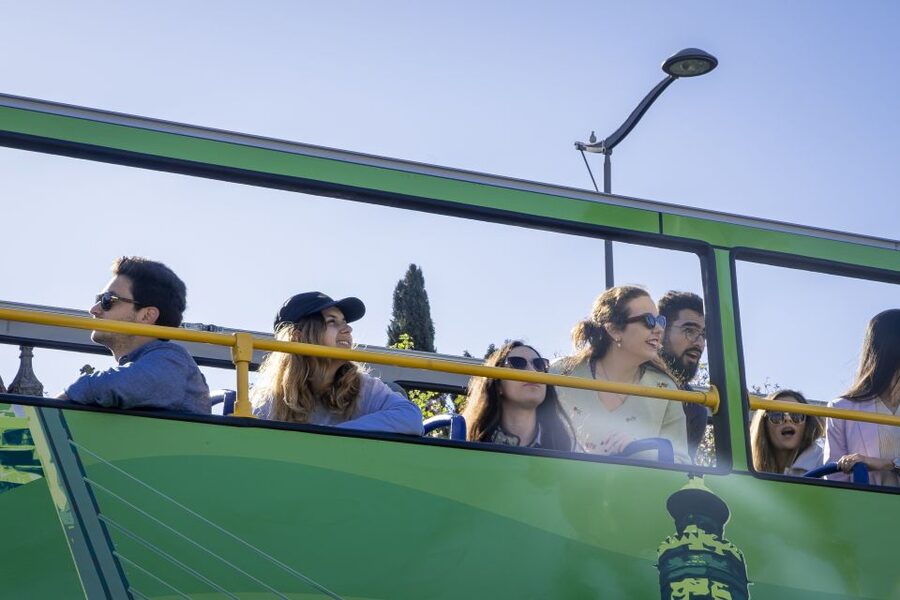
I would recommend this pass to you if you are visiting Seville for a short stay, want a quick city overview, or find long walks difficult. It is also useful if you are staying outside the historic center and want a simple way to connect distant parts of the city.
Families may like the open-top format and the freedom to break the day into shorter sections. Older visitors can remain seated for the full circuit, then choose only the stops that feel manageable. First-time visitors gain a clear sense of direction before committing to a full day on foot.
You may get less value if you prefer walking everywhere or plan to spend your time inside a small group of central sights. The bus does not replace visits to Seville’s major interiors, and it cannot take you through the narrow heart of Santa Cruz. It is best used as an overview, transport option, and planning tool.
The ticket also works well for a rainy day. You can stay on board for the 75-minute loop, listen to the audio, and use the next day for outdoor stops. That flexibility is more useful than it may first appear.
My practical verdict on the $32 price
At $32, I see this as a fair buy when you use both days. The strongest value comes from four features working together: repeated boarding, a route with 14 stops, two neighborhood walking tours each day, and the chance to cover distant parts of Seville without arranging separate transport.
The weakest value comes from riding only once. If you have just a few hours and already know Seville, a single loop may feel too passive. You are paying for time, not just mileage, so plan to make several stops.
I would begin with the full route, then spend the rest of the first day at Plaza de España, María Luisa Park, or Macarena. On the second day, I would use the bus for Triana, Cartuja, or any place you skipped. That approach turns a sightseeing ride into a practical two-day framework.
Should you book the Seville bus pass?
Book it if you want an easy overview, need flexible transport, or can give Seville two days. The open-top view, 14 stops, river crossings, and Santa Cruz and Triana walks give the ticket more substance than a simple drive around the center.
Skip it if you want a tightly guided history lesson or plan to spend nearly all your time walking between the cathedral, palace, and nearby lanes. The audio can be uneven, and some sights are only passed rather than visited.
For most first visits, I would book it when the price fits your budget, then use it actively. Ride the whole route once, get off at the places that catch your eye, and save the included neighborhood walks for a day when you want Seville at street level.
FAQ
How long is the complete bus route?
The full circuit takes about 1 hour and 15 minutes.
How long is the ticket valid?
The ticket is valid for two consecutive days from the time you first activate it.
How many stops are included?
The route has 14 stops, beginning at Torre del Oro and covering areas including Plaza de España, Cartuja, Isla Mágica, Macarena, Plaza del Duque de la Victoria, and Plaza de Armas.
Can I get on and off as often as I want?
Yes. During the two-day validity period, you can board and leave the bus as many times as you like.
Are walking tours included?
Yes. The activity includes walking tours of Santa Cruz and Triana, advertised as two walking tours each day.
Which languages are available for the audio guide?
Recorded commentary is available in Spanish, English, French, German, Italian, Russian, Dutch, and Portuguese.
Is the bus suitable for people with reduced mobility?
Yes. The bus is adapted for people with reduced mobility. Smoking is not allowed, and pets are not permitted except for assistance dogs.
Recently added in Seville
- Gibraltar Day Trip from Seville + Rock Tour★ 4.0 · 179 reviews
- Seville: Sherry Wine Tasting with Light Snacks★ 4.9 · 183 reviews
- Seville Aquarium Admission Ticket★ 4.0 · 185 reviews
- Seville: Electric Bike Tour in Small Group★ 4.9 · 185 reviews
- Seville: Hospital de los Venerables Ticket with Audio Guide★ 4.6 · 190 reviews
- Flamenco Dance Class in Seville with optional Flamenco Costume★ 5.0 · 191 reviews
- VIP Guided Seville Alcazar Pre-Opening, Cathedral & Old Town★ 5.0 · 191 reviews
- Tablao Flamenco Orillas de Triana Ticket★ 5.0 · 195 reviews
Seville Tours, compared.

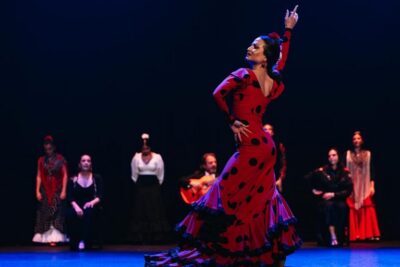
Live Flamenco Dancing Show Ticket at the Theater
Read the review →

1-Hour Guadalquivir River Sightseeing Eco Cruise
Read the review →
Cathedral, Giralda & Alcazar Entry With Guided Tour
Read the review →
Priority Access Cathedral, Giralda & Alcázar Tour
Read the review →Browse the lists this tour appears in